F.G. PHOTO STUDIO
How can FashionGo make on-trend product photos easy and affordable for Sellers?
FashionGo’s marketplace relies on strong product imagery to earn buyer trust, but many small and mid-sized sellers lack in-house photo capabilities. Traditional shoots were often $2,000+ per session, location-bound, and difficult to coordinate due to manual processes. As a result, low-quality photos hurt the platform’s look and feel and weakened the buying experience. FashionGo needed to lead with trend-forward, high-quality standards to consistently control marketplace quality, strengthen brand trust, and expand customer touchpoints.
How can FashionGo improve
the seller buying experience by offering
vendors a new photography service?
PRODUCT
Background
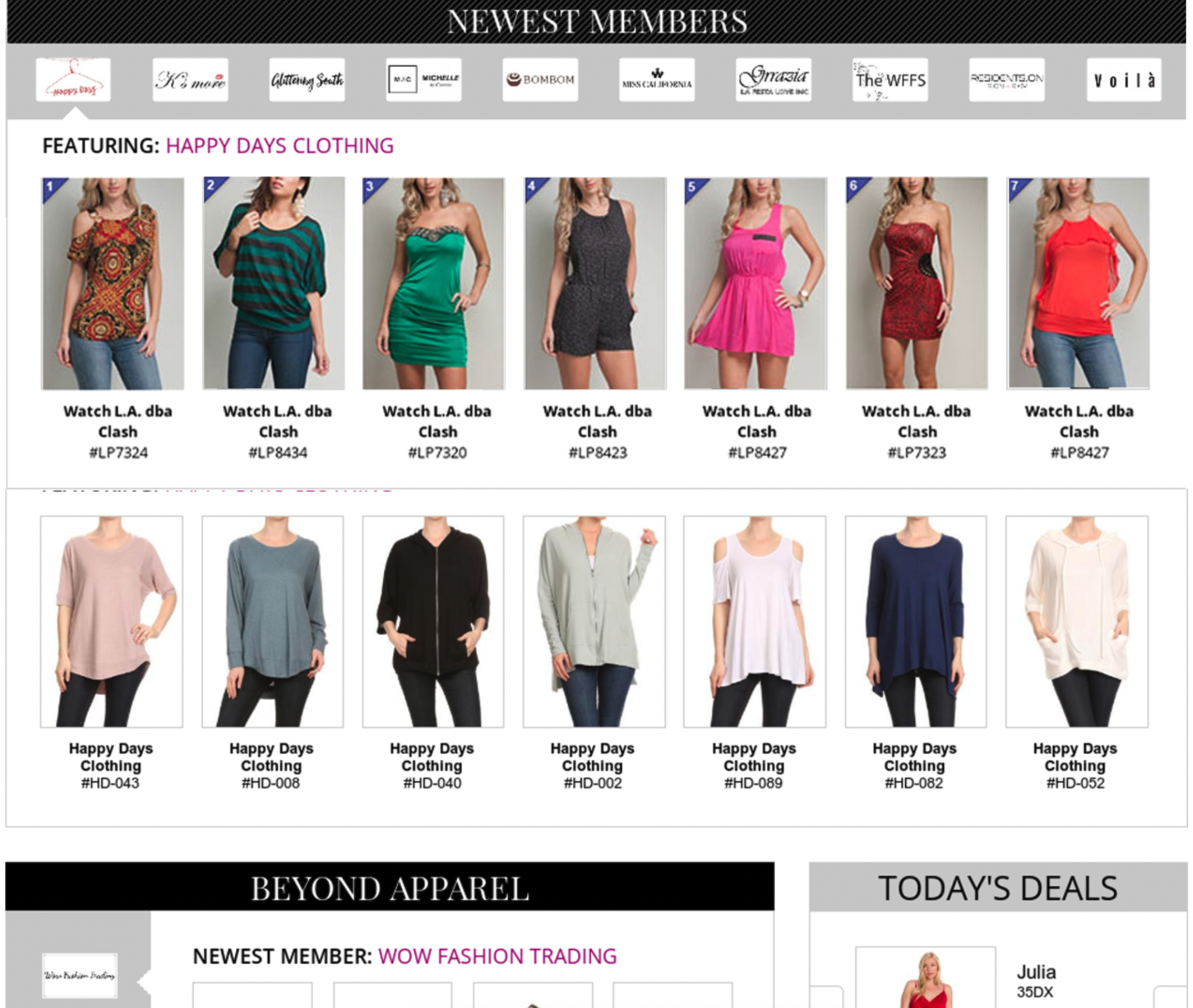
FashionGo’s marketplace success depends on product imagery, but most sellers lack in-house capability to produce consistent, on-trend photos. Outsourcing was common, yet the experience was often expensive and difficult to navigate due to manual processes and unclear pricing. This project was needed to turn product photography into an accessible platform service that sellers could use quickly and confidently. As listing quality varied widely, buyers hesitated to purchase and smaller vendors struggled to compete—creating a direct risk to conversion, perceived trust, and seller retention.
Problem
Many small and mid-sized FashionGo vendors struggled to produce trendy, high-quality product images. Traditional photo services were costly (often $2,000+ per session), hard to access for sellers outside major cities, and required heavy coordination—making it difficult to maintain strong visuals and compete online.
Solution
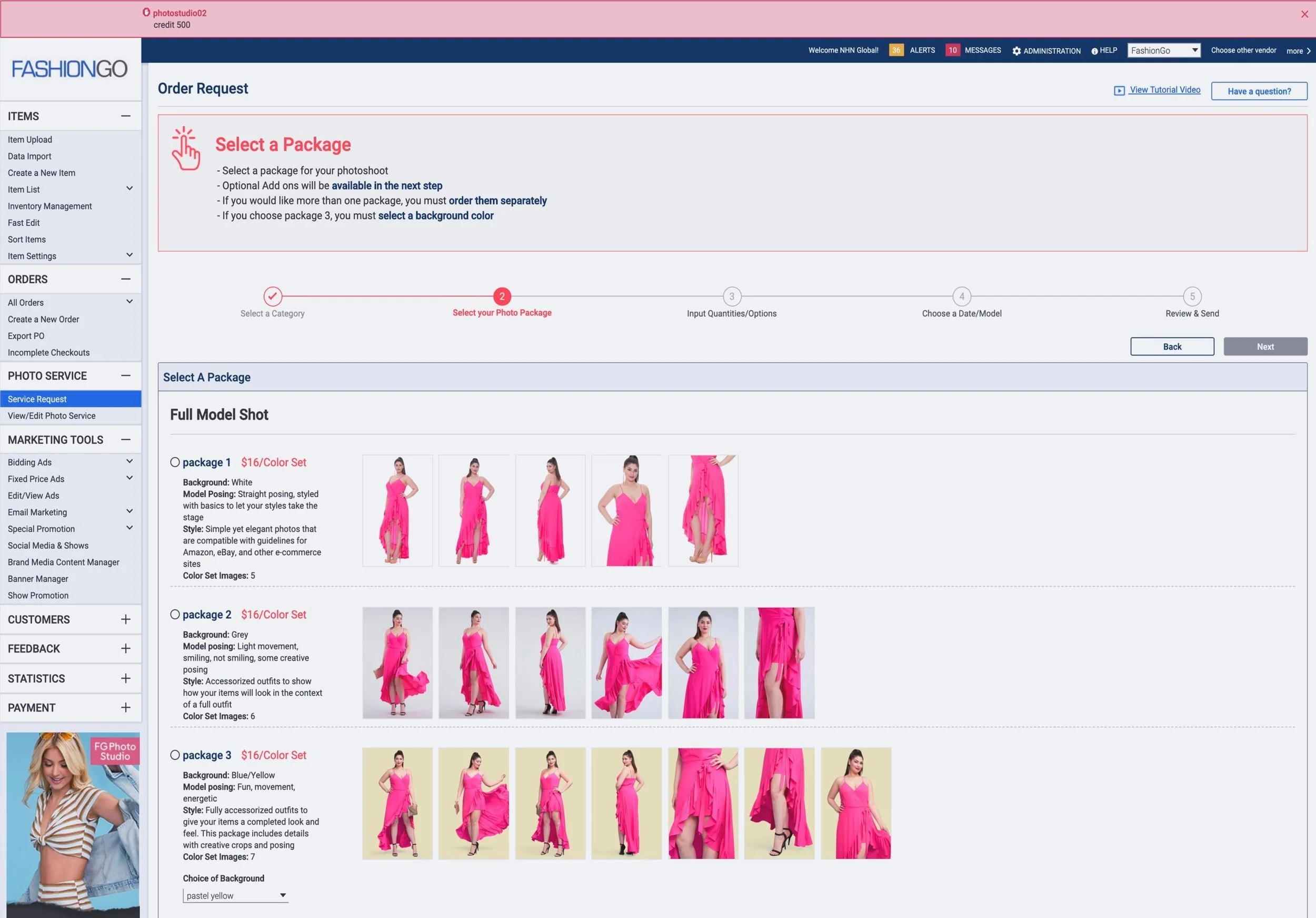
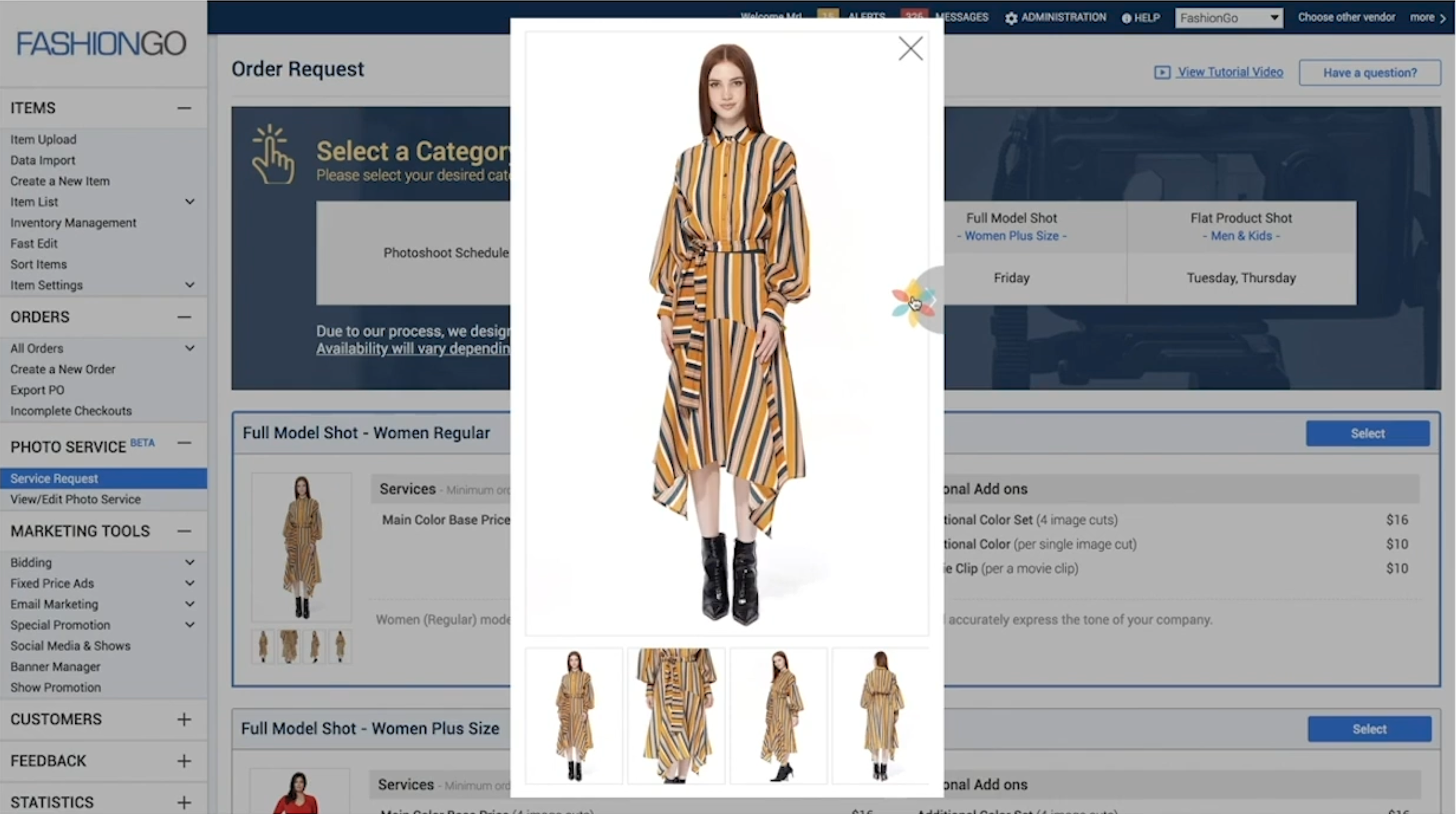
Built and launched FashionGo Photo Studio, a platform-native photography service designed for fashion e-commerce. Sellers could complete the entire flow inside the vendor admin—browse models, select shoot dates, and receive instant quotes—making ordering faster and more predictable. The differentiated value was combining trend-aligned quality with frictionless access and transparent pricing, so premium visuals became attainable for smaller vendors.
STRATEGY
01. What to Achieve
Frame Question
How can we help sellers get on-trend product photos quickly and affordably?
Outcomes
Raise marketplace image quality standards across FashionGo Platform
Support buyer acquisition by improving product visuals and perceived trust
Strengthen seller retention by making FashionGo the default partner for product imaging
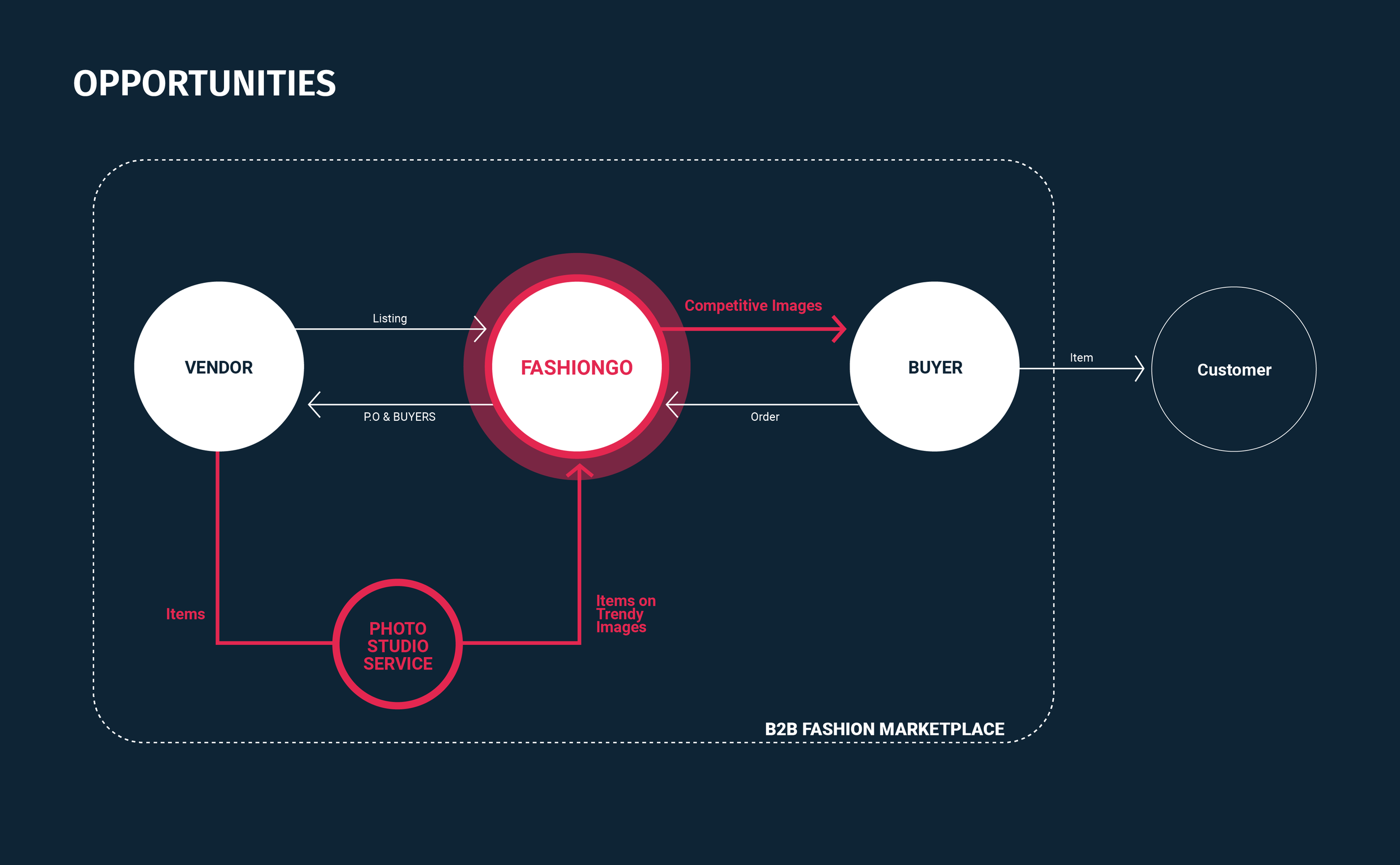
02. Where to Play
Target: vendors without in-house photography resources, especially outside major fashion hubs
Focus: the end-to-end ordering experience (model selection → scheduling → quote → order submission)
Priority needs: brand-fit models, fast turnaround, clear pricing, minimal coordination overhead
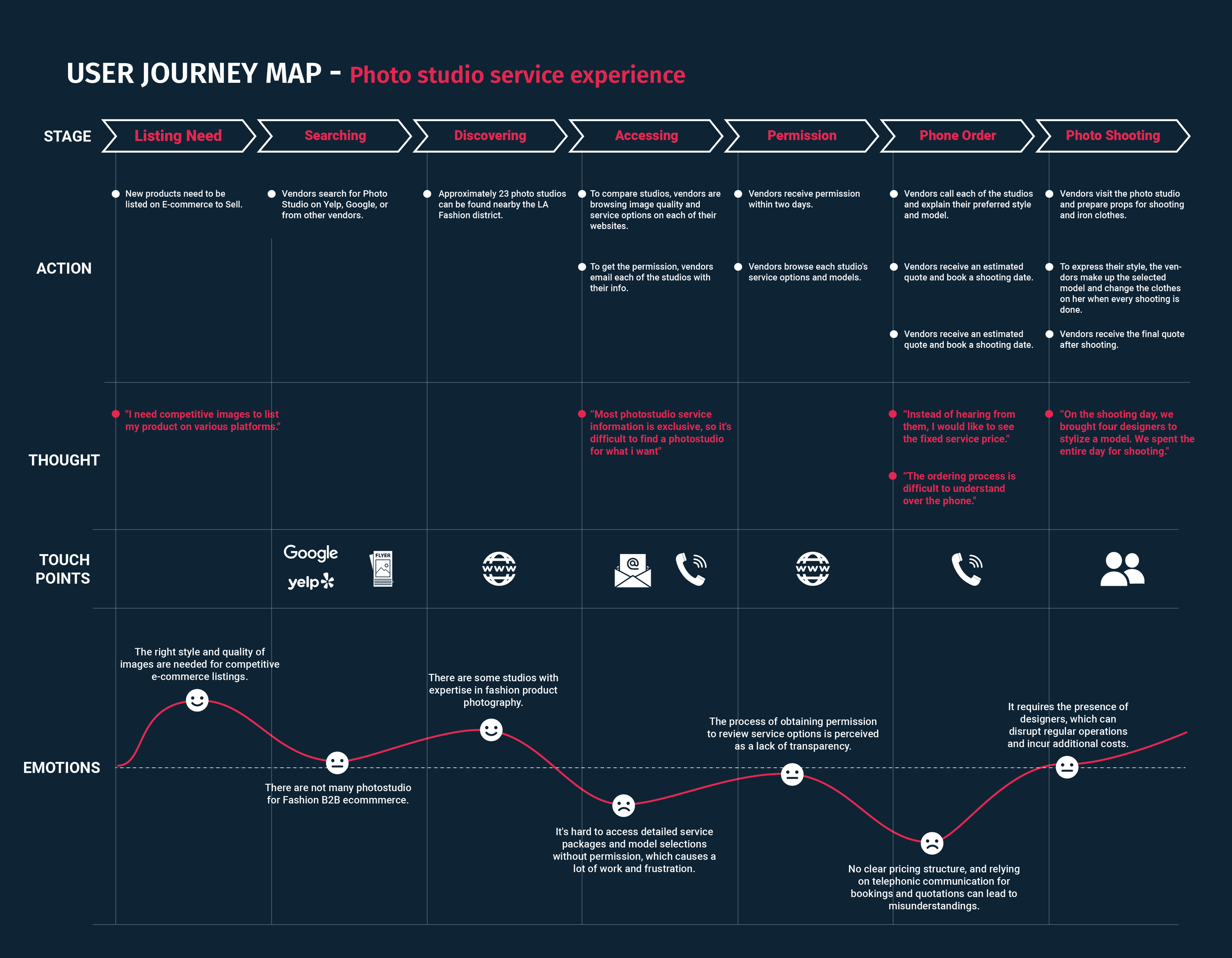
03. How to Win
Affordable access to diverse model selection: Sellers can choose from a wide range of models that match their brand identity—without paying premium studio rates or spending time sourcing models themselves.
Fast, predictable ordering with instant quotes: Sellers get clear pricing upfront and can book shoots quickly, reducing back-and-forth coordination and helping them launch products on time.
Less operational disruption: By removing manual studio communication and unclear workflows, sellers spend less time managing shoots and more time running their business.
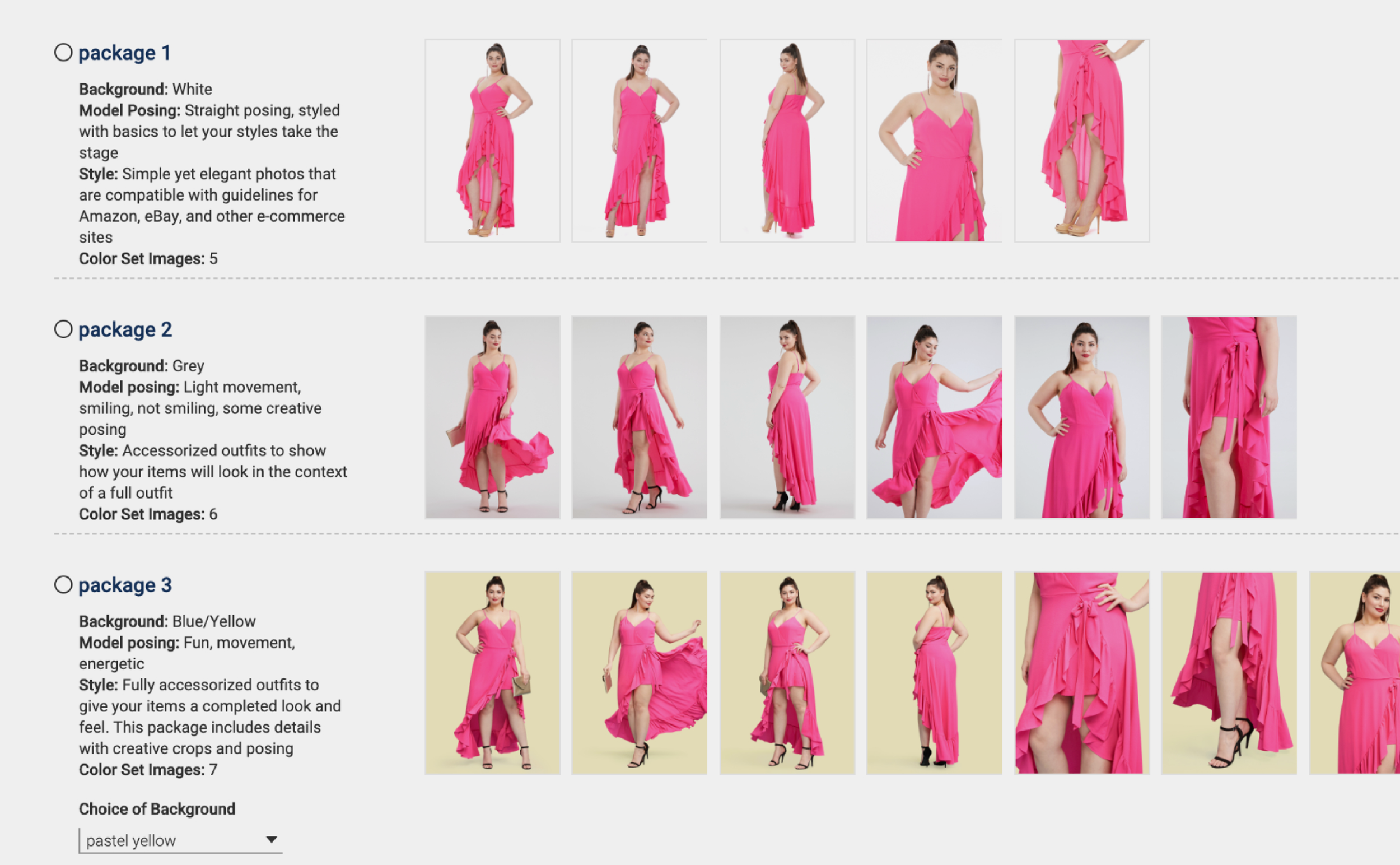
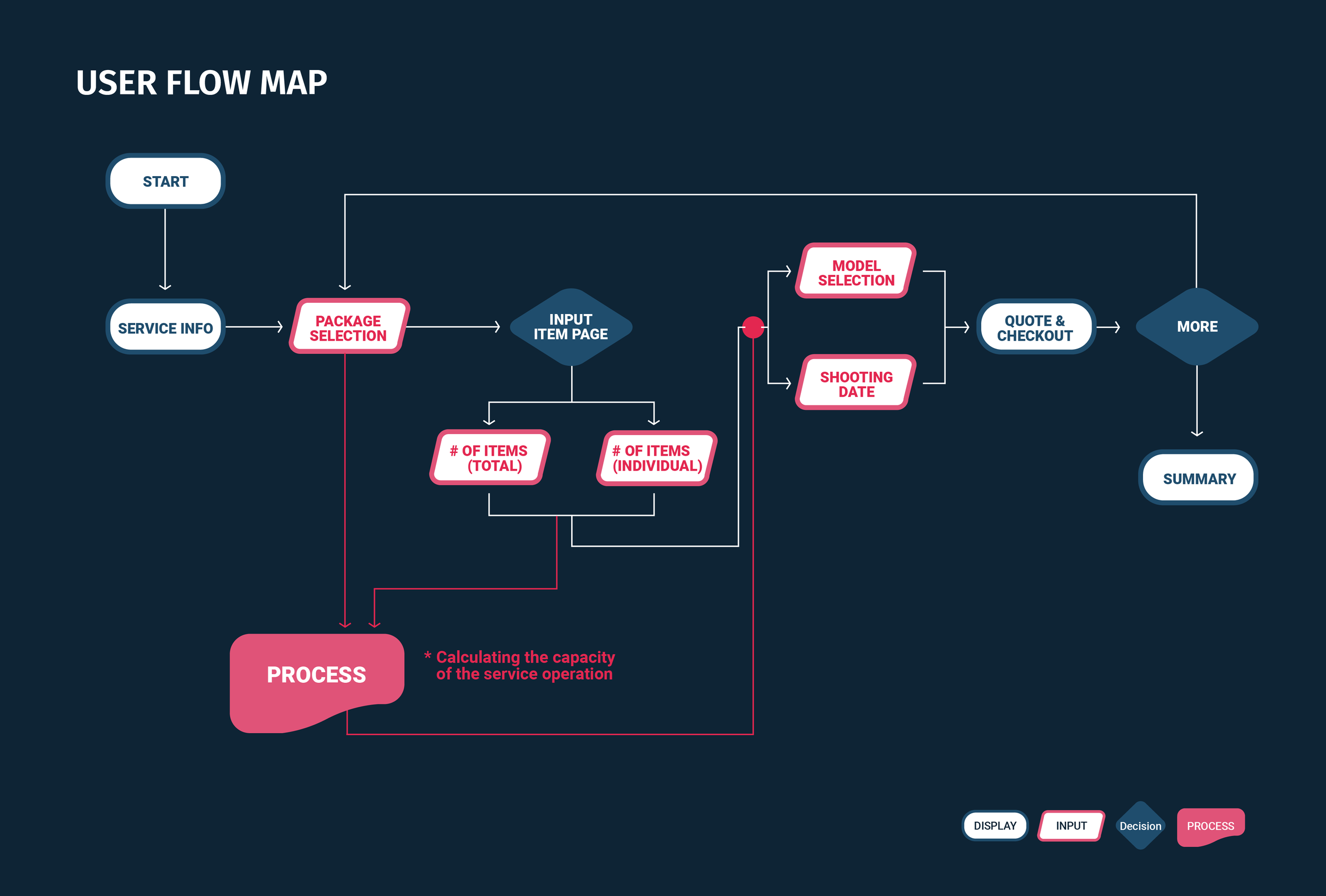
04. Capabilities to Implement
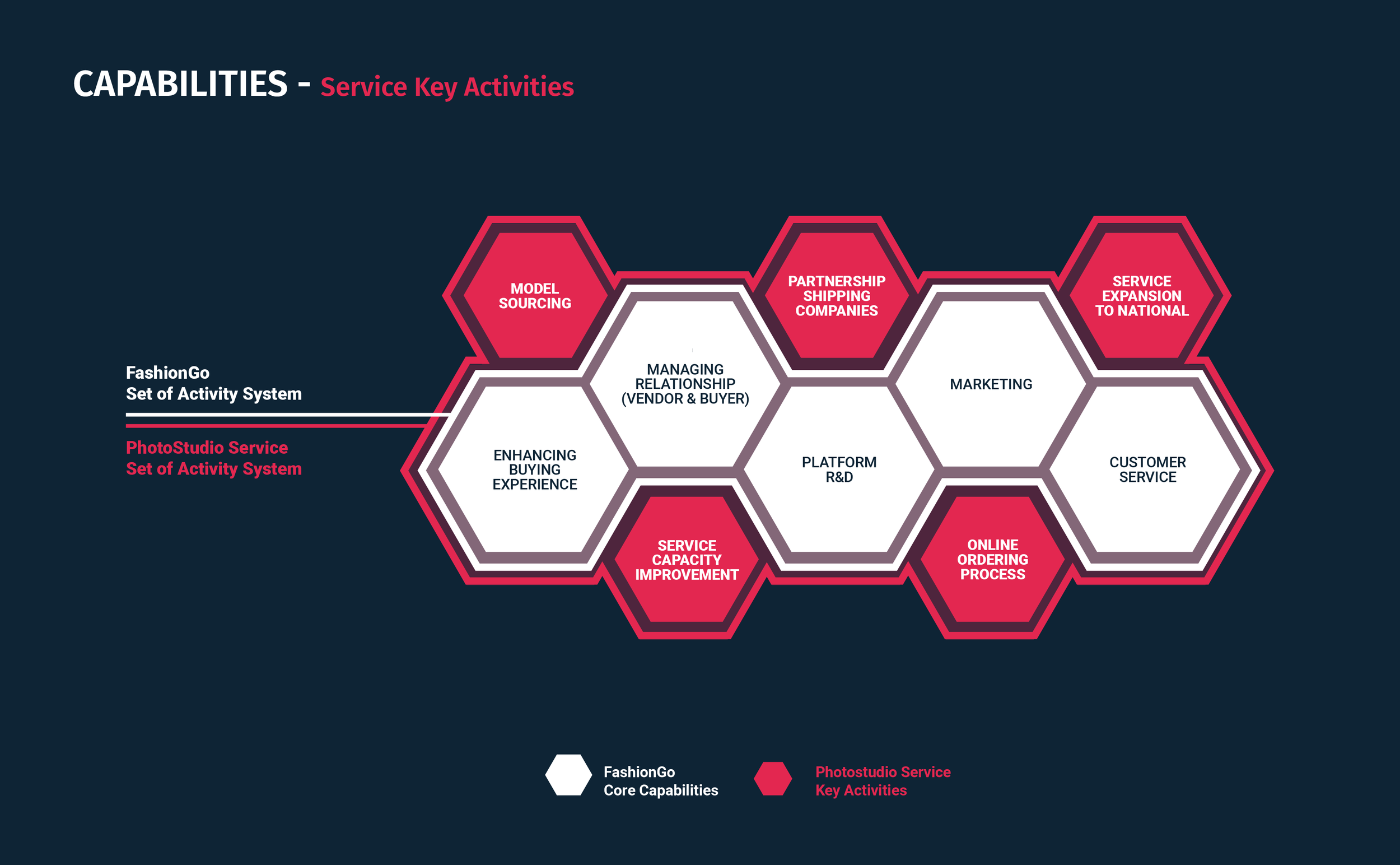
Build a simplified ordering UX with clear terminology, sequencing, and information hierarchy
Scale operational capacity to handle higher daily order volume
Partner with model agencies to expand model options aligned to different brand styles
Enable broader coverage through shipping/logistics partnerships
Use FashionGo marketing channels to drive awareness and adoption
05. Management System to Grow
Track user confusion and drop-offs using N-click analytics
Run A/B tests to refine terminology, ordering sequence, and information hierarchy
Maintain an iteration loop: measure → test → learn → ship improvements
06. Next Step / Future Foresight
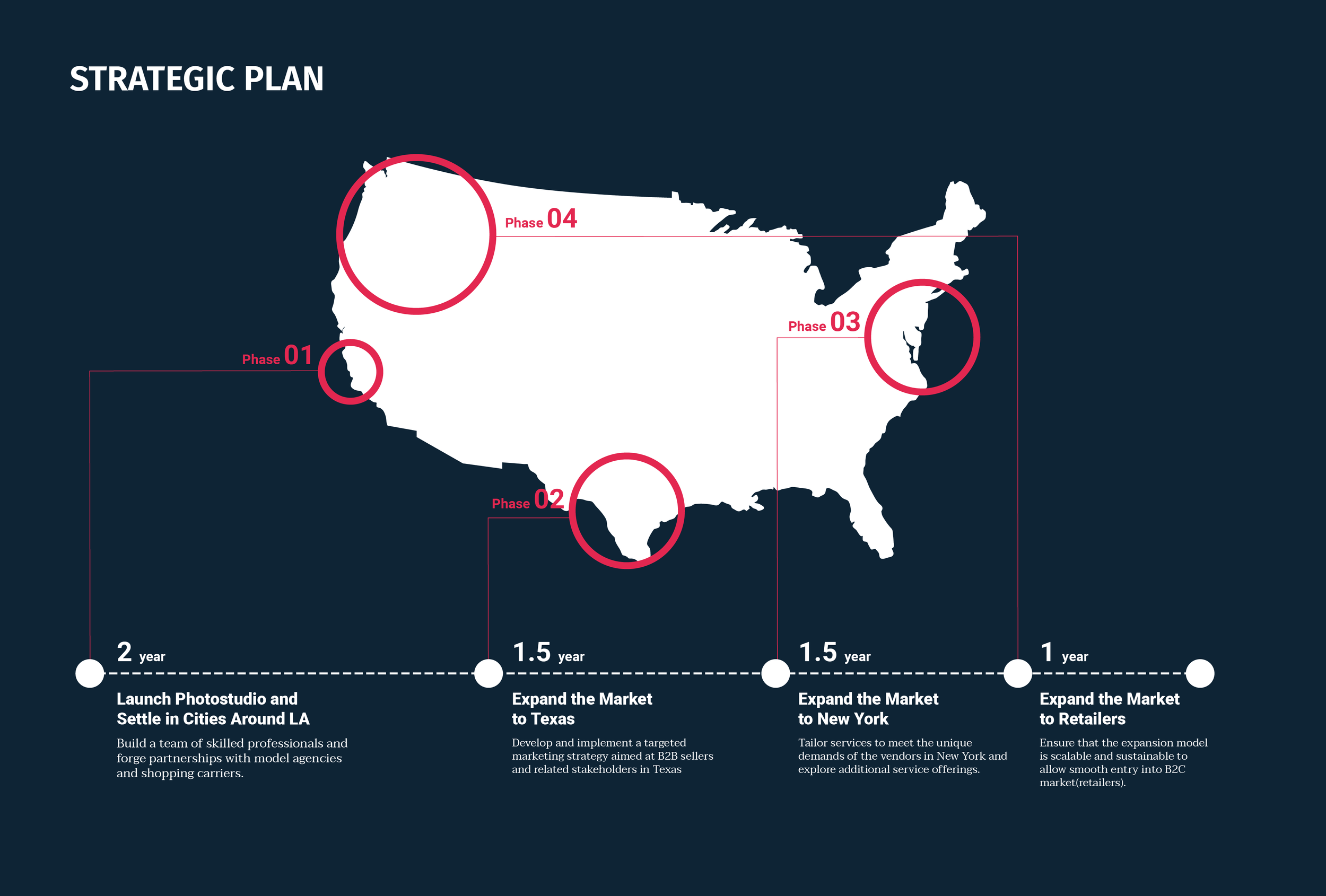
Expand the service nationwide beyond Los Angeles to support FashionGo’s 10,000+ B2B sellers
Leverage LA fashion resources (models, styling, production) to serve rural/suburban sellers
Increase model variety and shoot concepts to match different brand identities and trends
Improve logistics partnerships to reduce turnaround time and broaden coverage
Build a scalable operating model to grow volume without sacrificing quality
F.G. PHOTO STUDIO SERVICE (A/B TEST)
How can FashionGo help B2B buyers feel in control when making a B2B purchase?
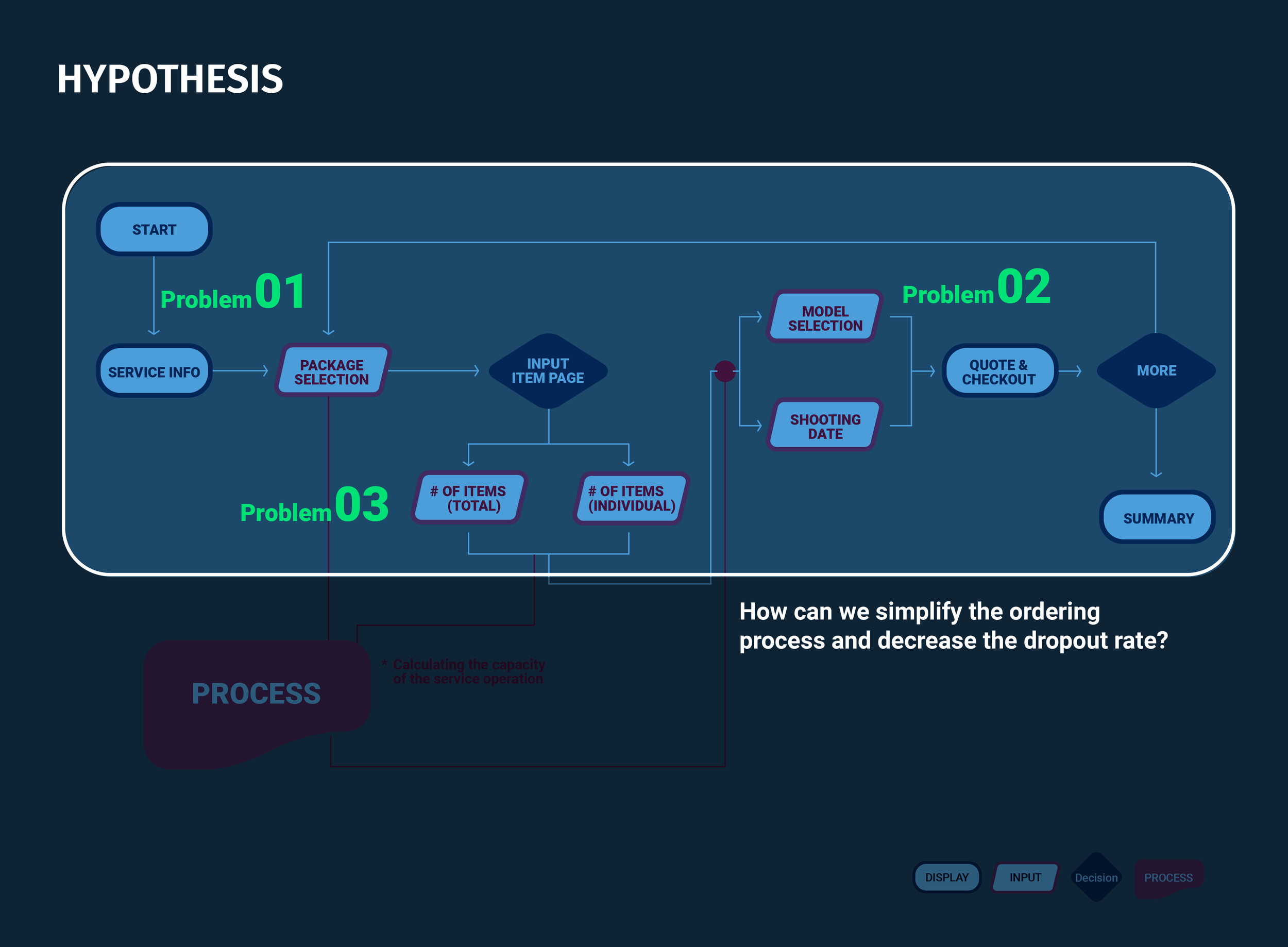
Online ordering for photo services was new in the market, so we needed to validate how well users understood the flow, terminology, and deliverables. Over a six-month beta, we tracked clicks and drop-offs and confirmed insights through interviews. Unclear steps and terms drove early exits, lowering conversion and increasing support requests. We addressed this through iterative A/B tests, adding guided step UI and simplifying terminologies to improve clarity.
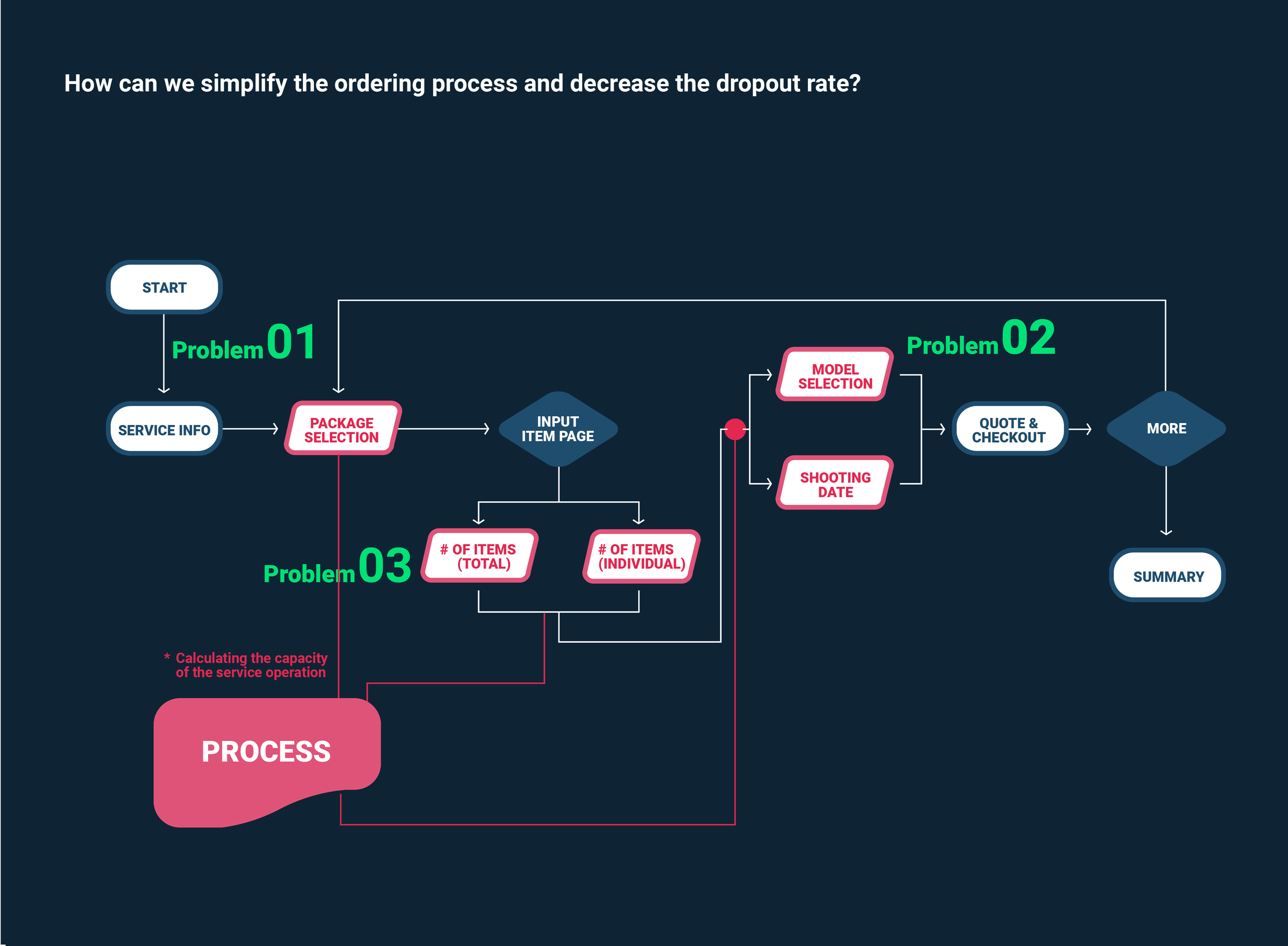
How can we simplify
the service ordering process
and clarify the terminologies for users?
PROJECT
Background
Online ordering for photo studio services was new to the market, so users lacked a shared understanding of terminology, packages, and delivery methods. During a six-month beta, we built a basic analytics system to track button clicks and page drop-offs, then validated insights through customer interviews. This project focused on improving clarity and learnability so first-time users could complete orders without heavy operational support.
Problem
Users were dropping off early and raising frequent questions because the ordering flow and service terminology were unclear, creating friction that reduced conversion and increased operational workload.
Solution
We iteratively improved the flow through A/B testing by restructuring information hierarchy, adding guided UI elements (progress bar, dashboard), prioritizing model selection earlier to surface value faster, and clarifying deliverables with tooltips and visual aids.
These changes reduced confusion while improving conversion and order success, lowering support burden and increasing operational efficiency.
TACTICS
Goal
Frame Question
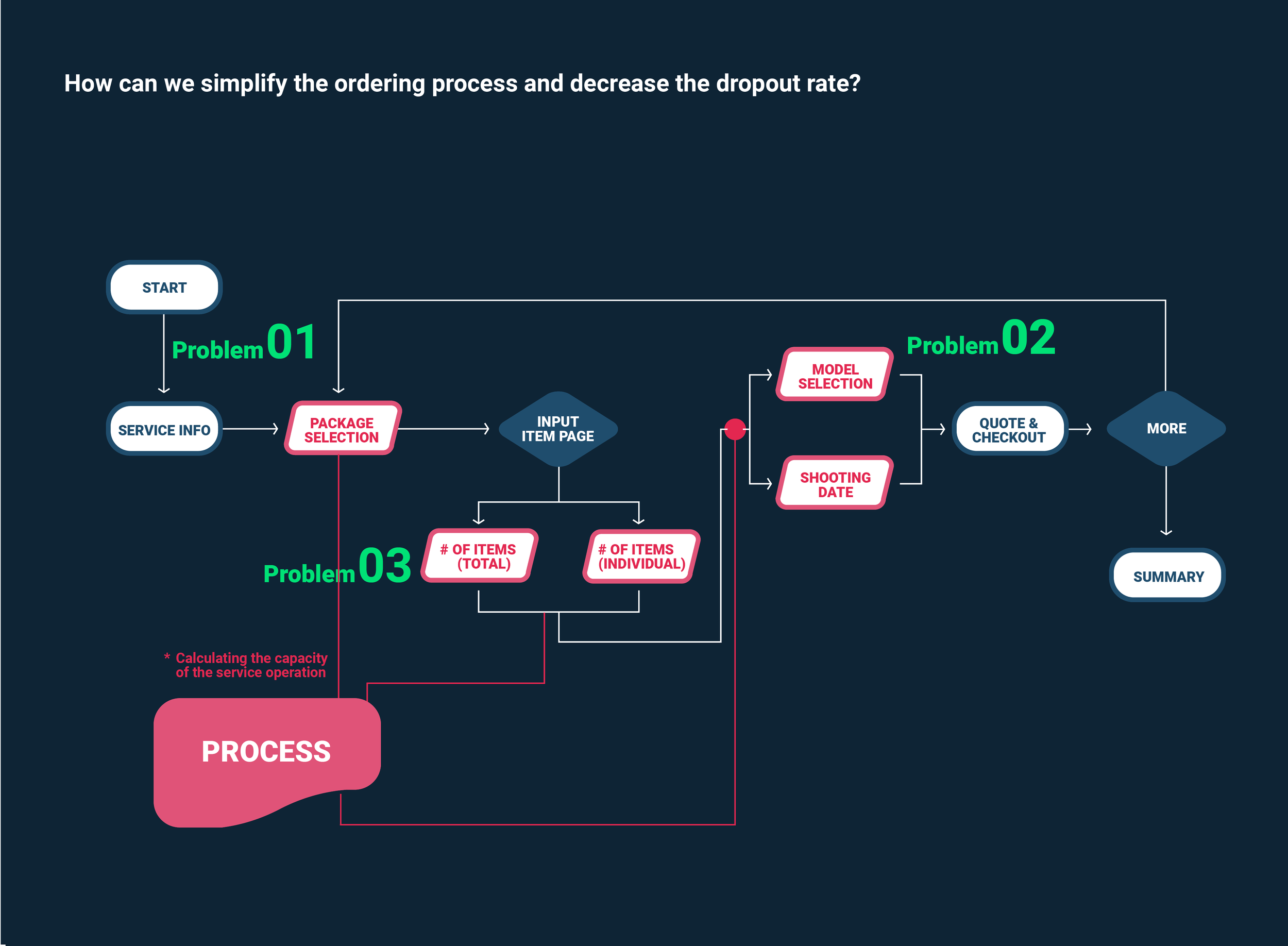
"How can we improve the clarity of our terminology and descriptions to increase the order conversion rate?"
Outcomes
Reduced bounce rates through clearer information presentation
Reduced operations workload by decreasing repetitive explanations
Expanded the user base by improving the first-time ordering experience
Problem 01
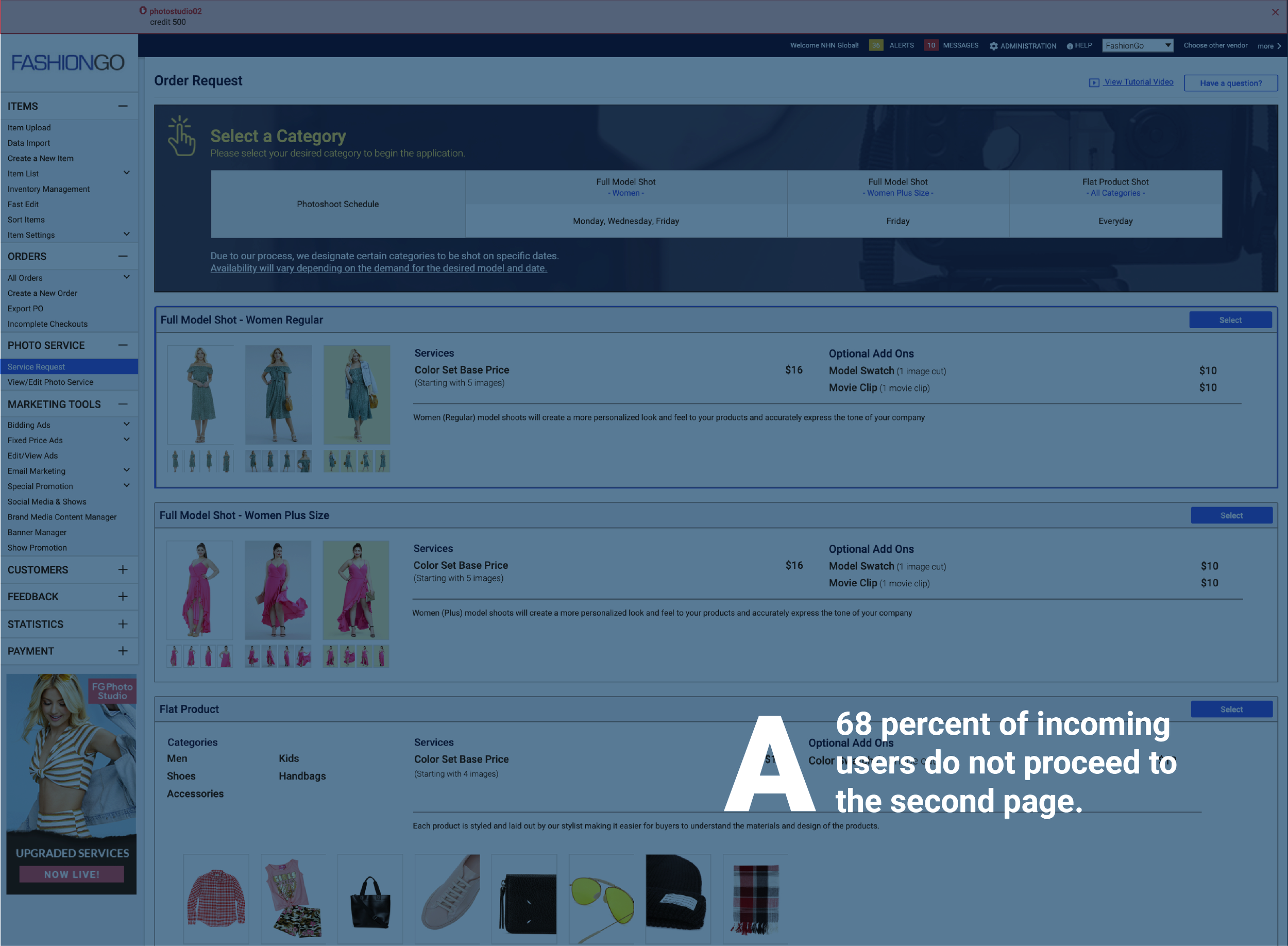
On the first page, there must be an entry barrier that
prevents users from moving to the next page.
Assumption
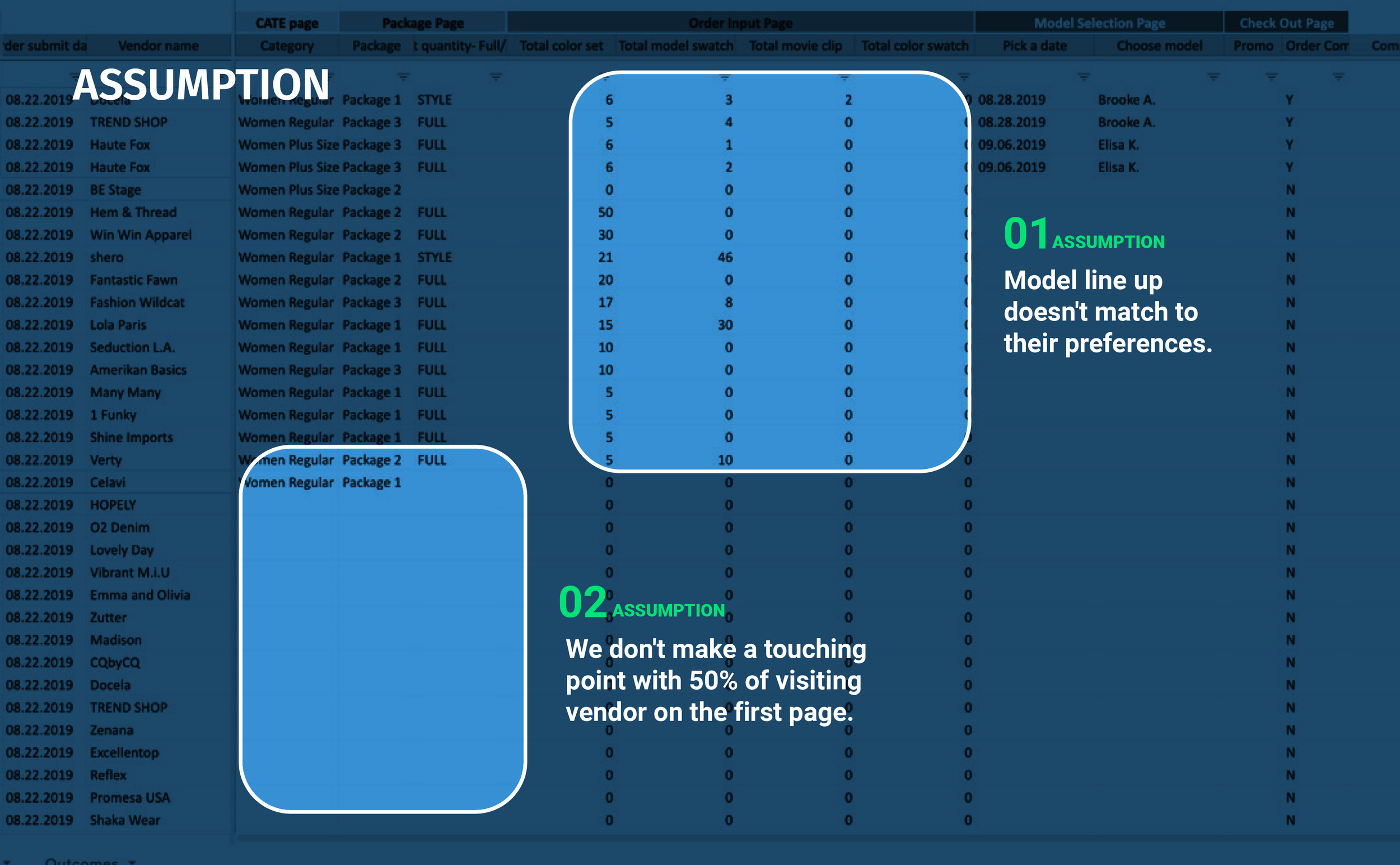
Users may fear getting charged just by entering the service, so they hesitate to proceed.
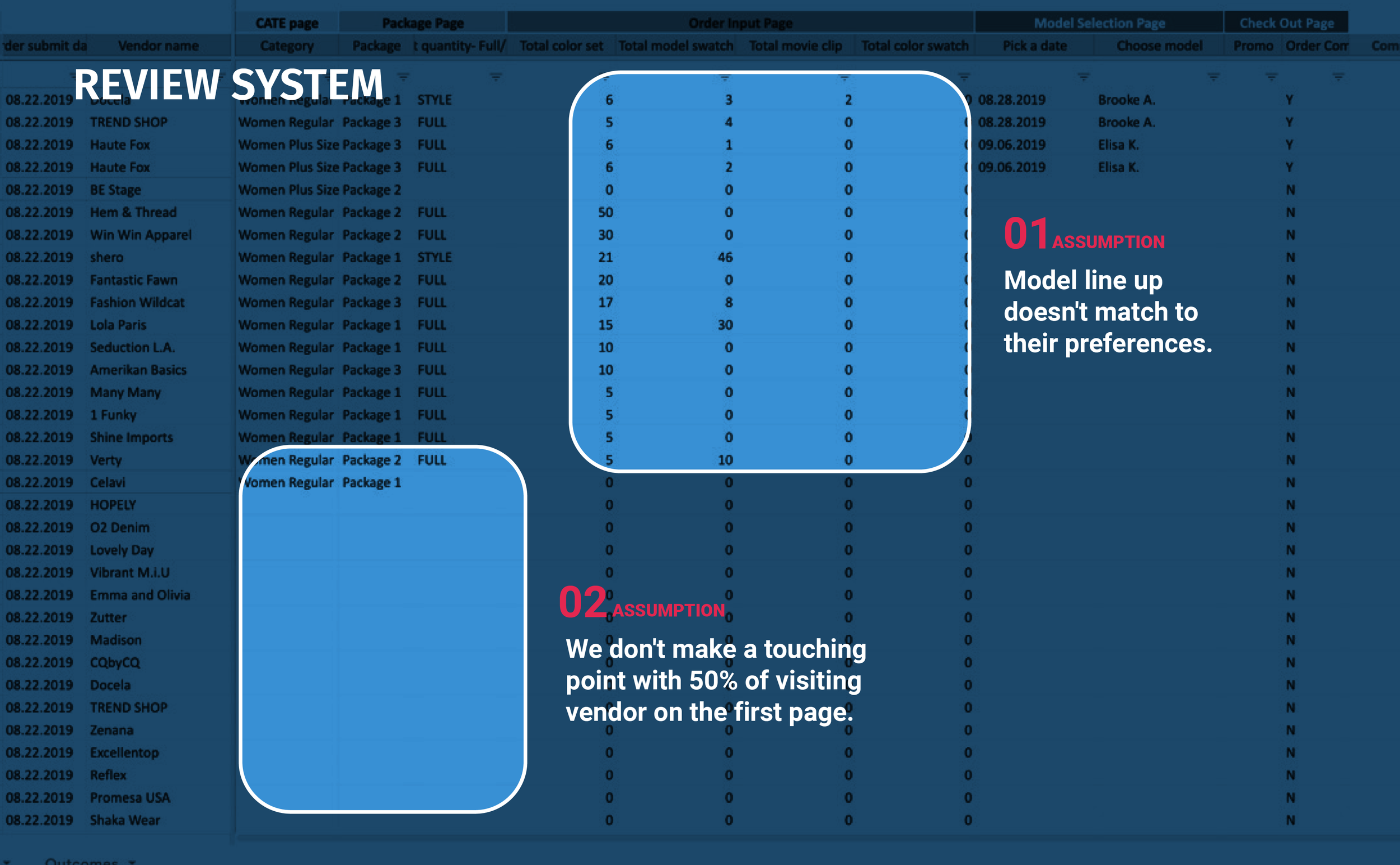
About 60% of users exit after the first landing page.
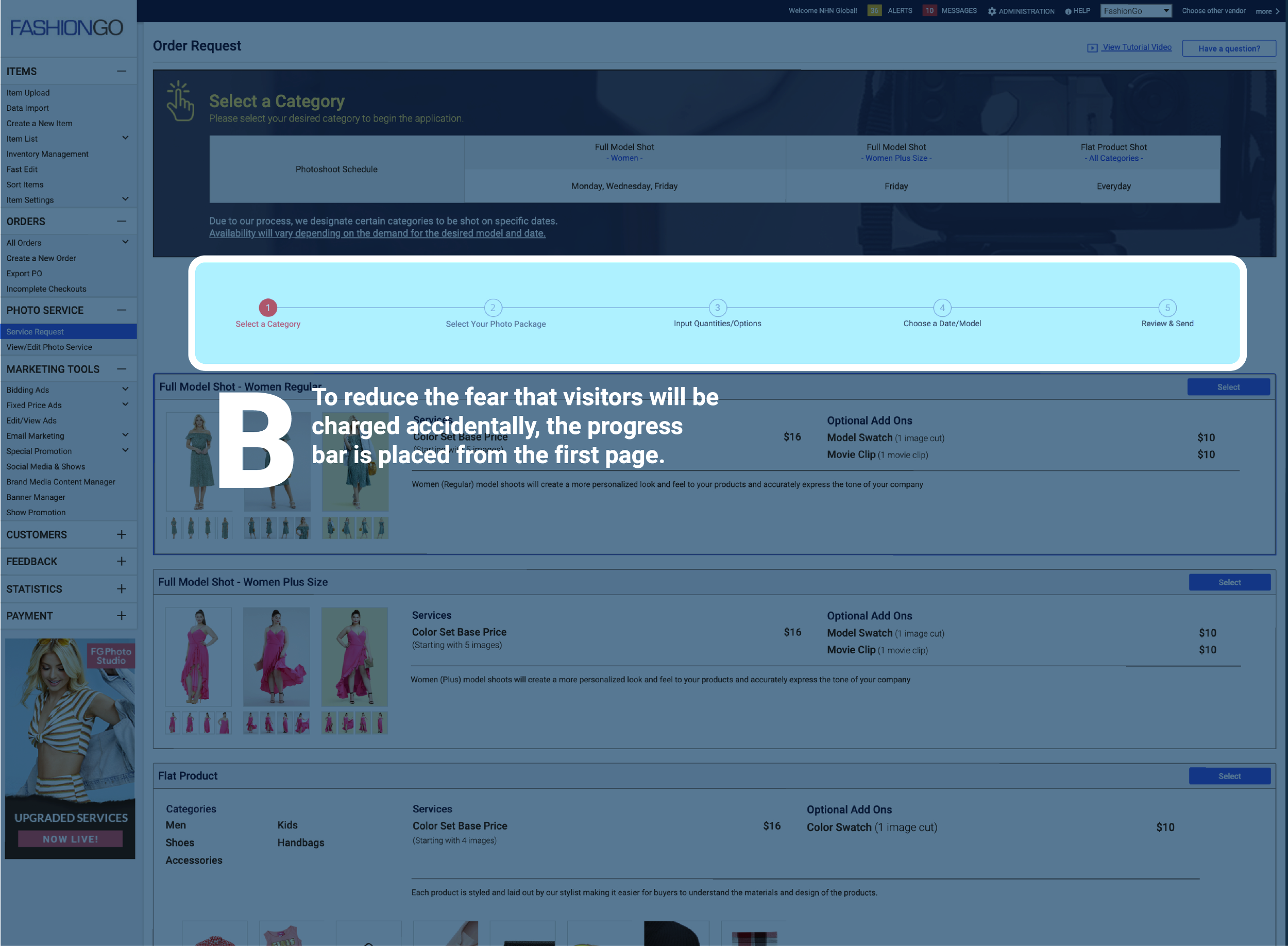
Hypothesis & Action
If we add a progress bar starting from the first page, users will better understand the steps and feel safer to continue.
Implemented a progress bar on every page (starting from page 1) with short step descriptions and remaining-step indicators.
Result
Conversion increased by about 22% from page 1 to page 2 after adding the progress bar and step guidance.
Problem 02
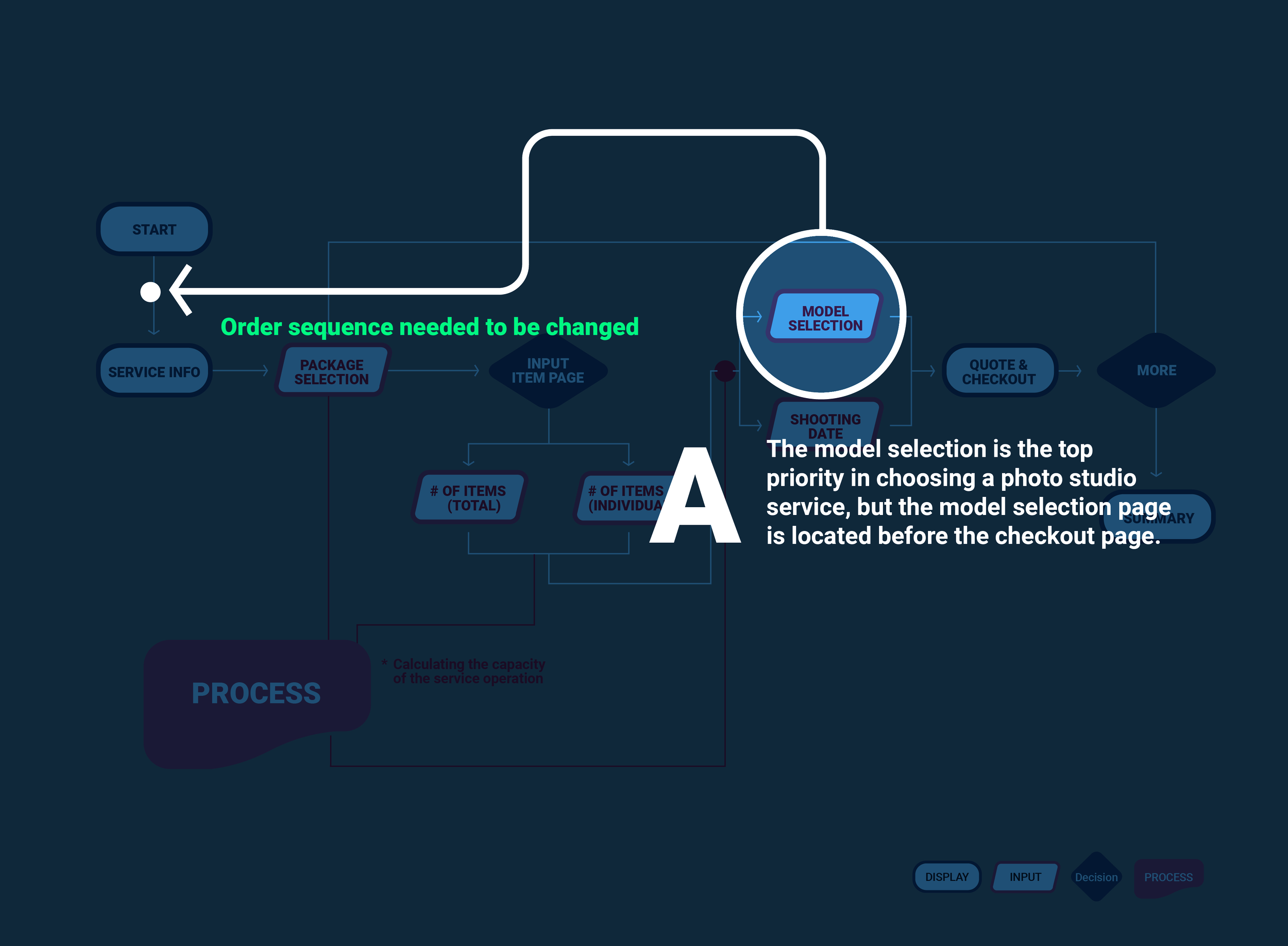
The Number of Incoming New Users
To FG Photo Studio Service Are Not Enough.
Assumption
The ordering sequence did not surface the most compelling value early, so new visitors were less motivated to explore the flow.
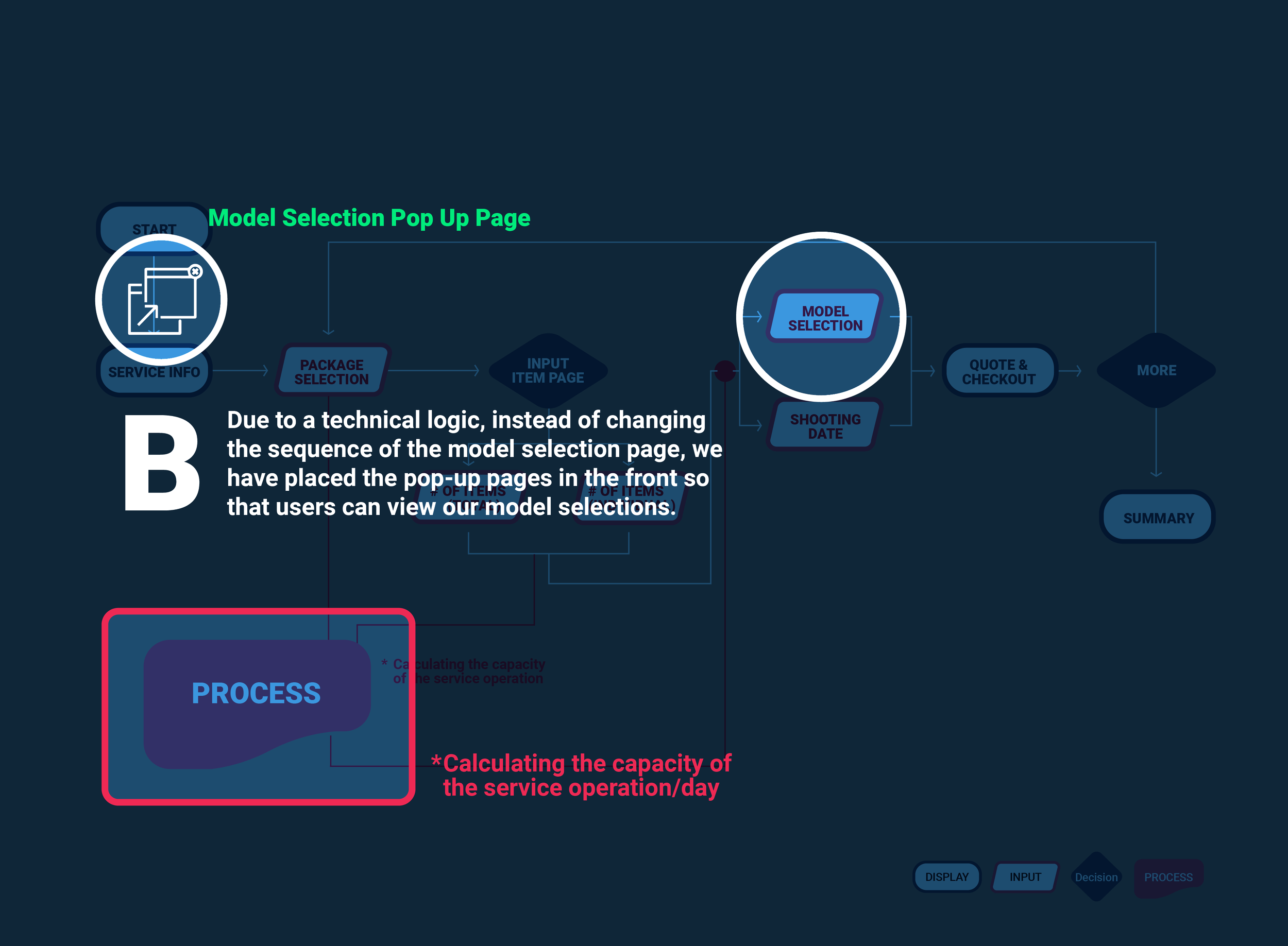
Hypothesis & Action
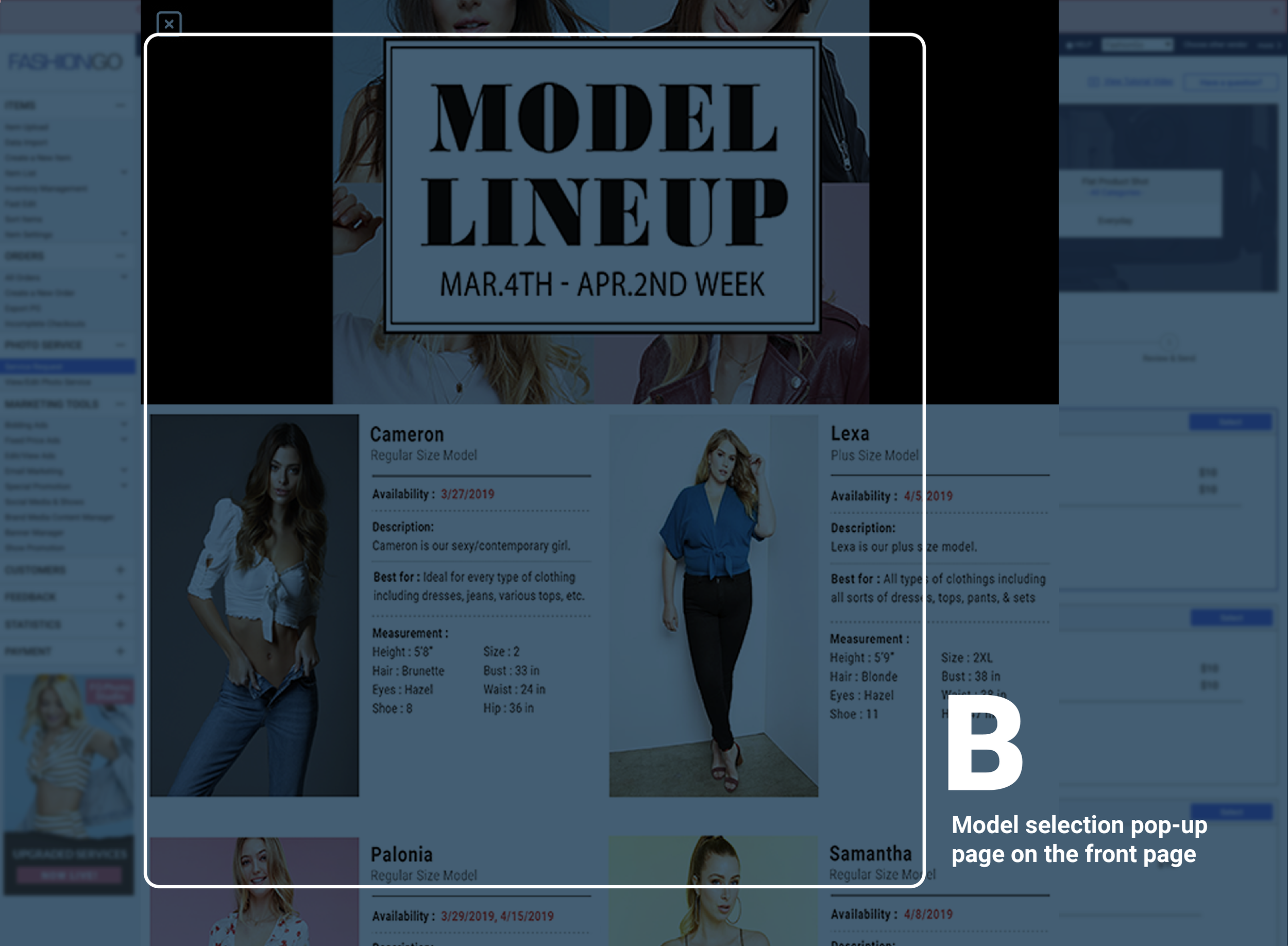
If we help users reach the model selection step faster—without changing the full ordering logic—more first-time users will continue deeper into the flow and reach the quote page.
Promoted the service through model-focused messaging and simplified options that helped users reach the model step faster.
Result
New session views increased by 15%, supported by faster access to the model step.
Problem 03
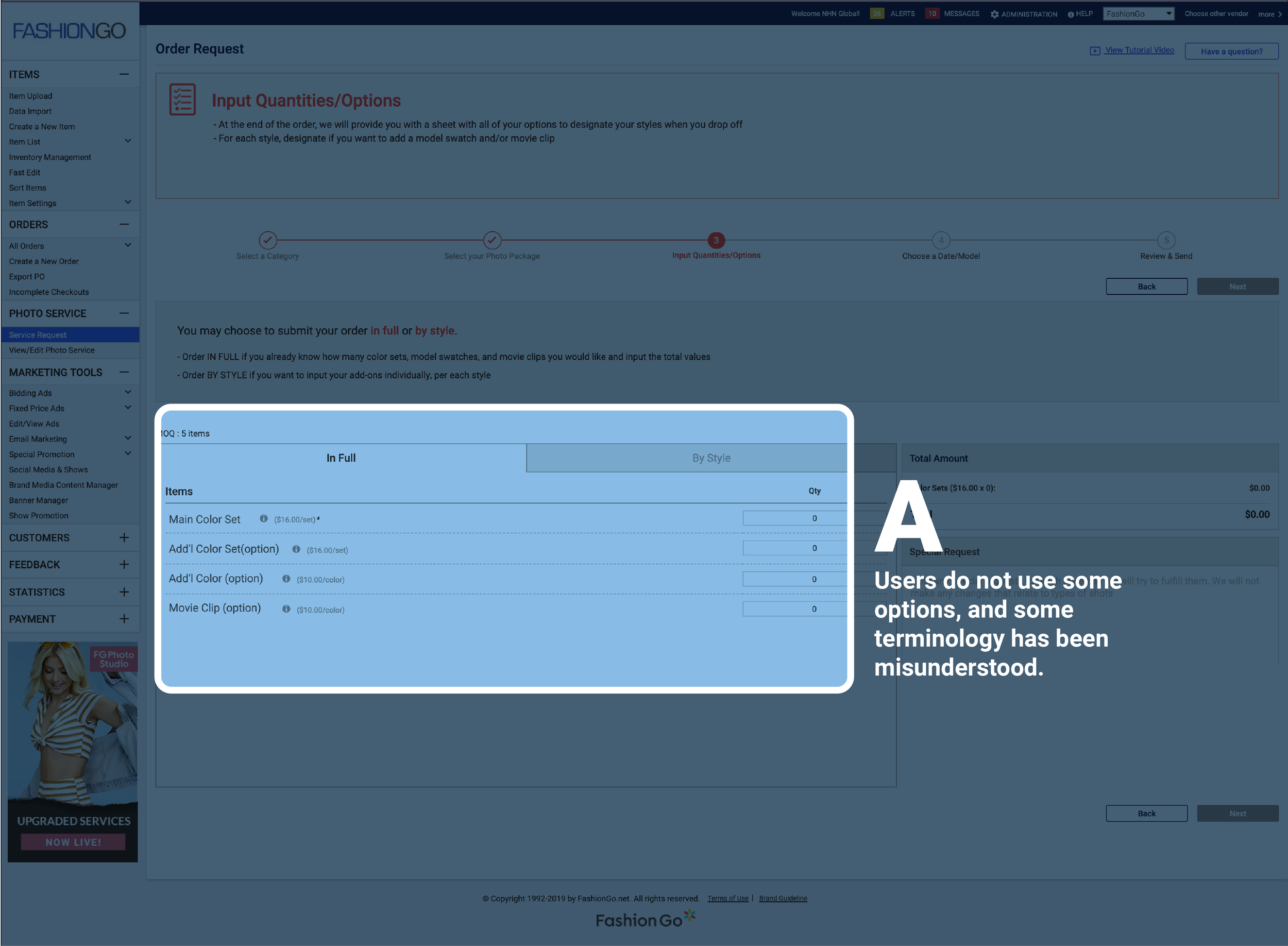
Customers misunderstood deliverables,
causing complaints and lowering order success.
Assumption
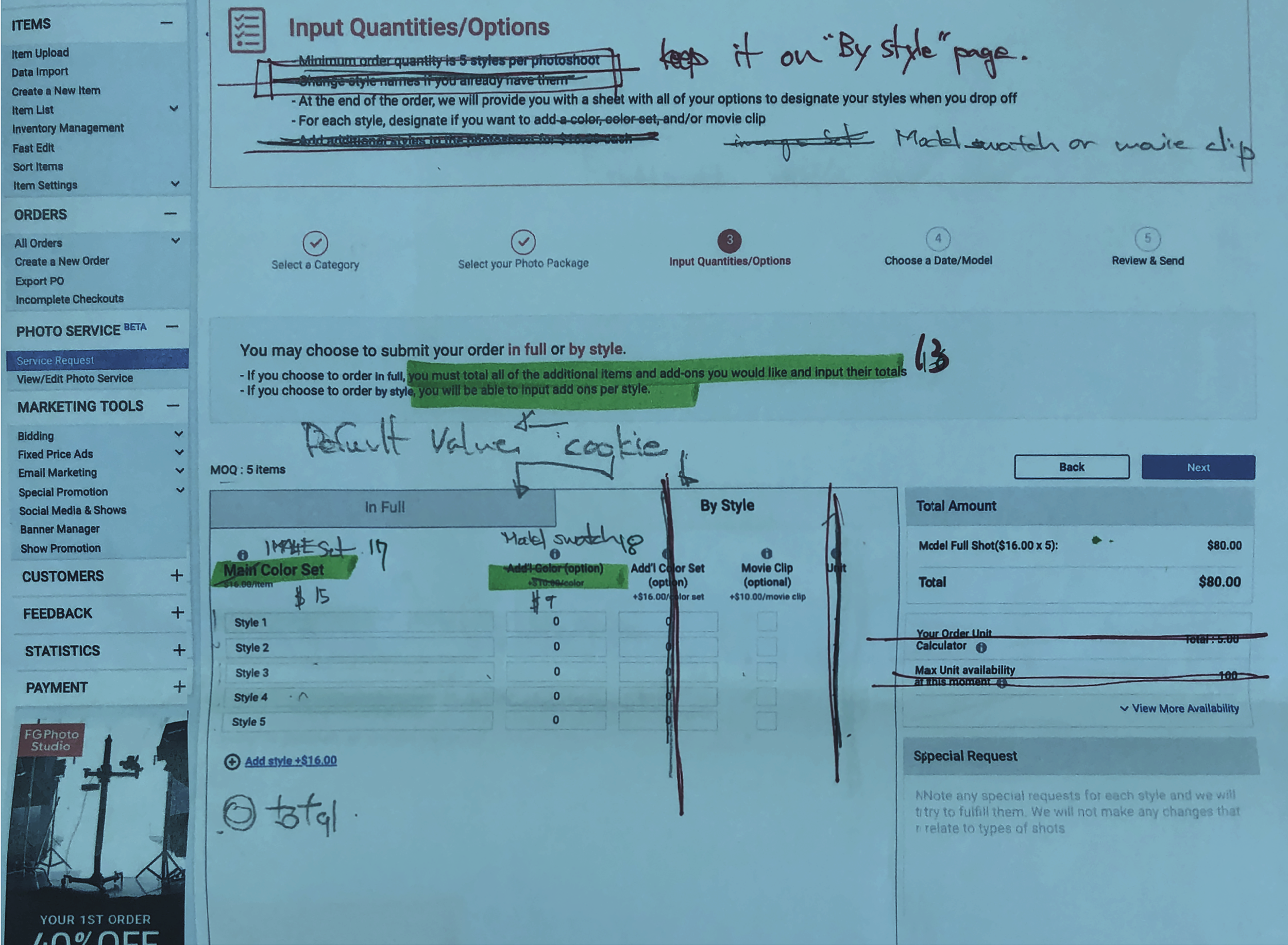
Terminology around deliverables (image sets, angles, add-ons, package styles) is unclear and can be misleading.
Hypothesis & Action
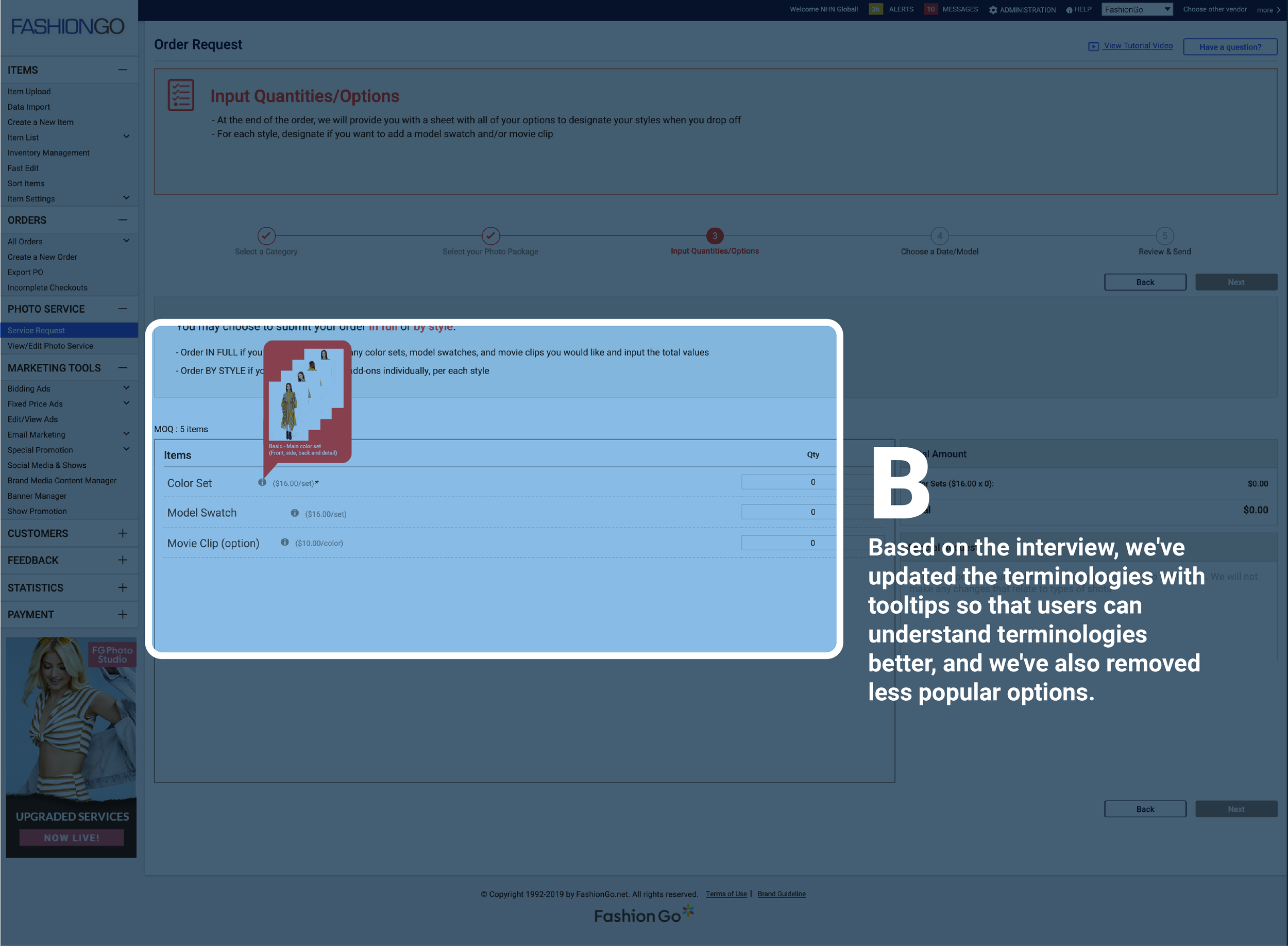
If we simplify terminologies and add visual tooltips, sellers will better understand deliverables, reducing complaints and improving order completion.
Removed low-use options, rewrote key terms, and added tooltip explanations with image aids to clarify what each selection includes.
Result
Order success rate increased by about 18% within a month.
Complaints decreased, improving operational capacity and reducing support burden.
PIAGGIO STATION
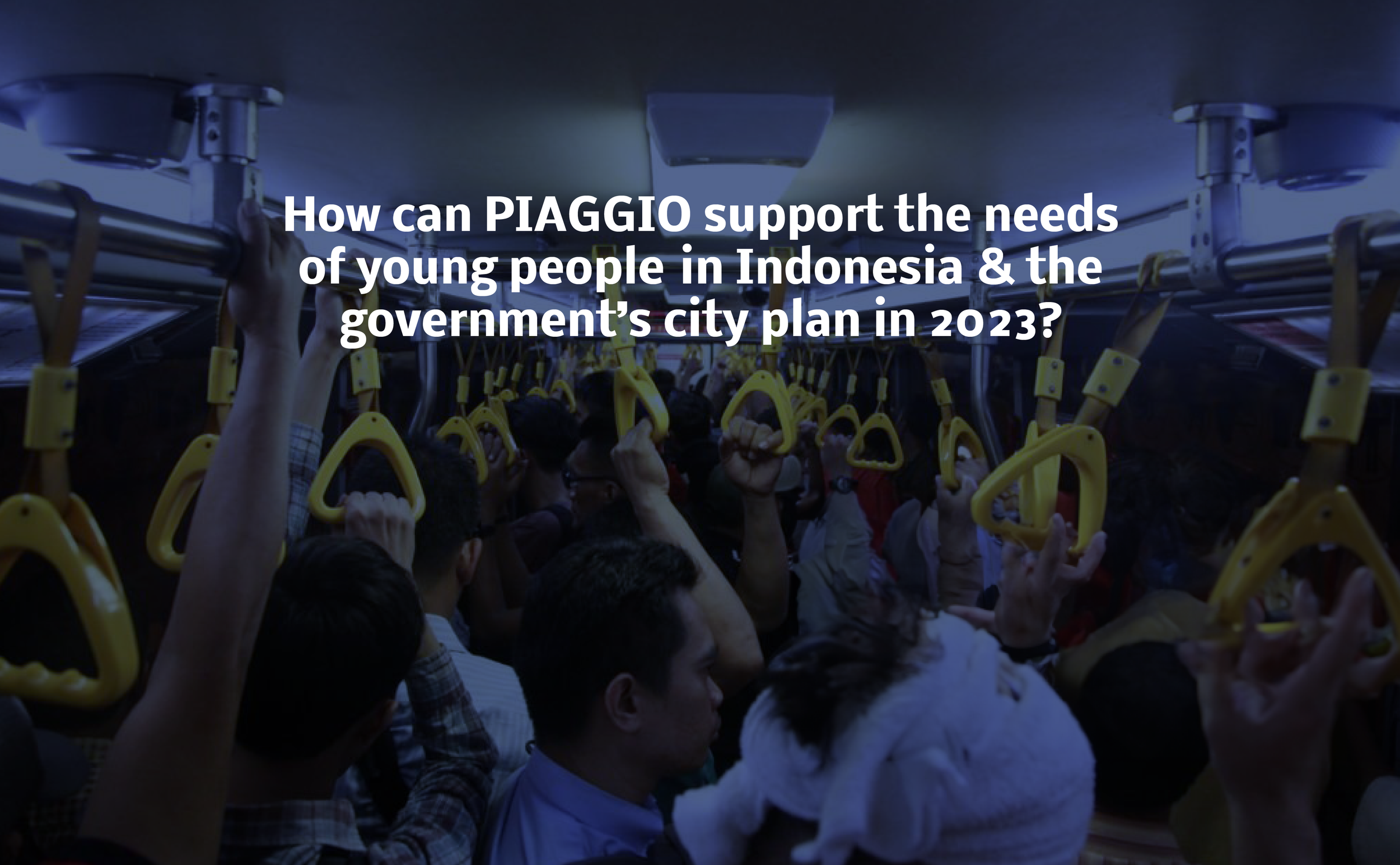
How can PIAGGIO stay competitive in 2023 by leveraging its core strengths?
This project, sponsored by PIAGGIO in 2013, aimed to address the company’s declining sales and weakening brand identity in recent years. PIAGGIO sought a design direction to remain competitive by 2023. To find the solution, We conducted extensive design and business research, including market analysis, target user research, future studies, STEEP analysis, technology trends, and generational cycle studies. We proposed PIAGGIO Station—a station-based micro-mobility service concept designed to engage young commuters.
How can PIAGGIO leverage
its core competencies to remain competitive
in the industry in 2023?

PRODUCT
Background
This consulting project, completed 10 years ago, applied multiple research methods including SWOT and STEEP analyses, generational studies, and future projections. The work was a collaboration between PIAGGIO, my ArtCenter graduate colleagues, and me. I evaluated PIAGGIO’s core capabilities and market positioning to narrow the focus to a specific segment. Interviews with Jakarta city planners highlighted a need for improved public transportation for young suburban commuters, and my proposal supported that direction by creating a more enjoyable commuting experience.
Problem
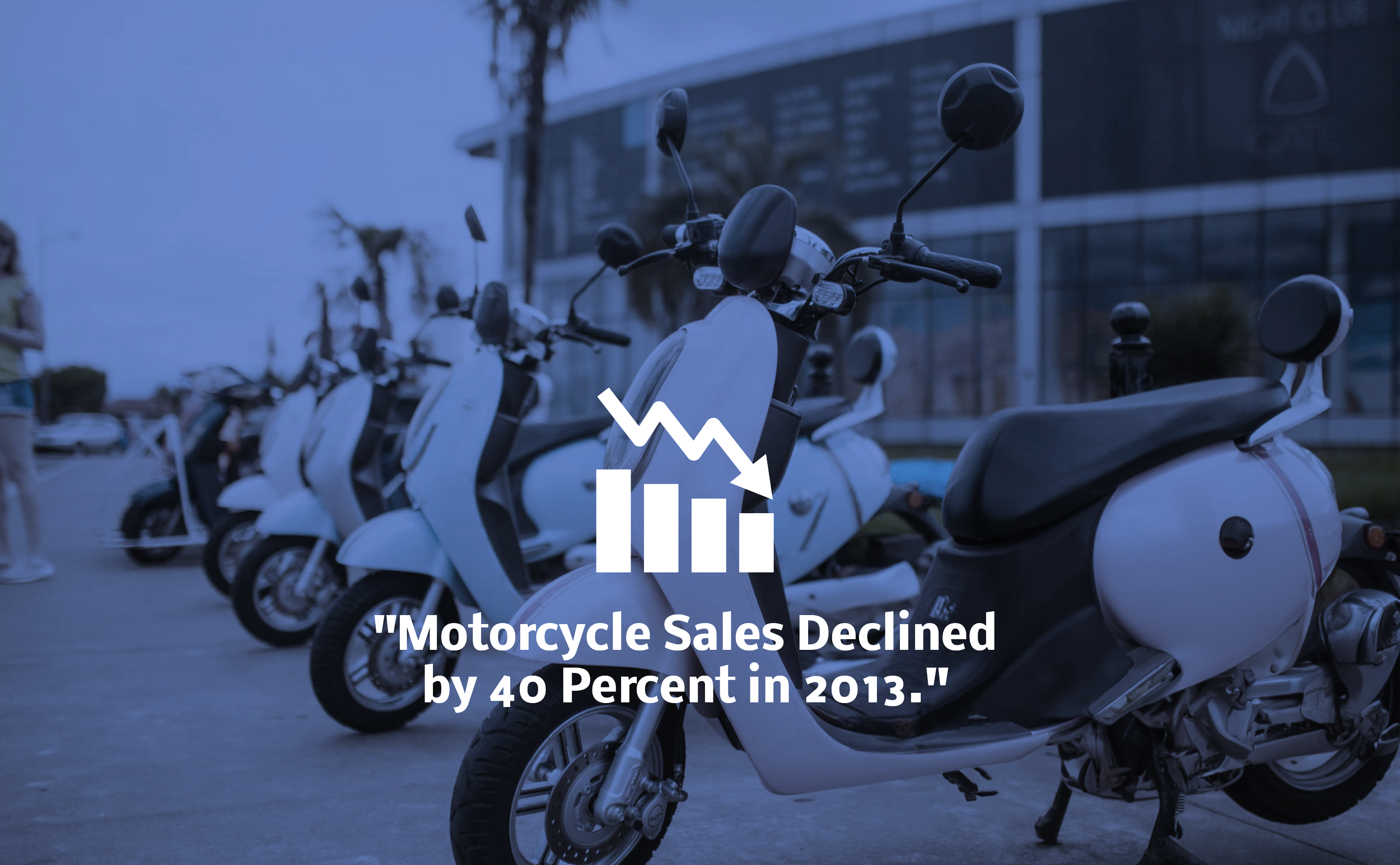
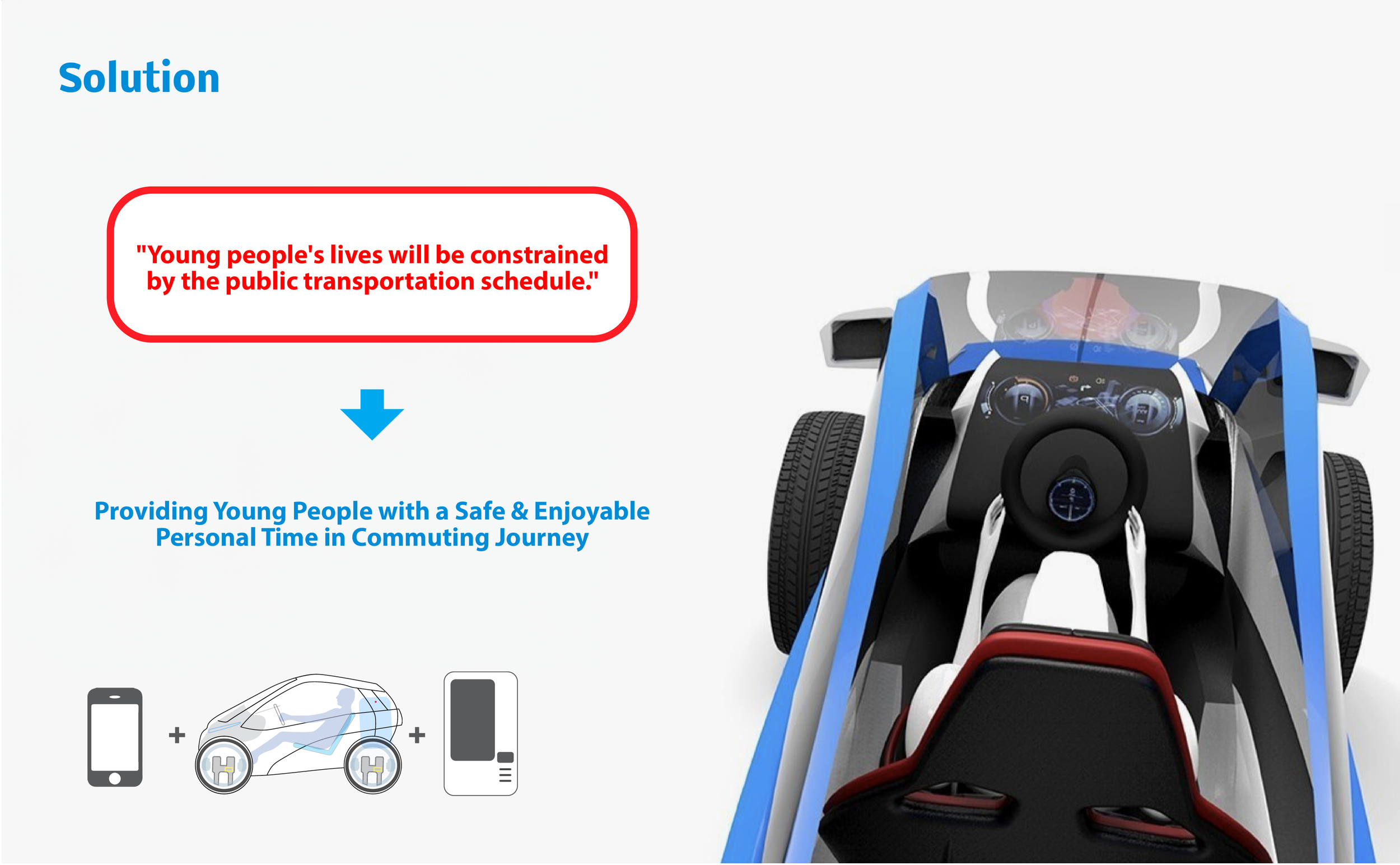
Motorcycles were becoming less appealing to Gen Z due to rising safety concerns, making it harder for PIAGGIO to stay relevant with the 18–30 segment. At the same time, more young people were moving to suburban areas and facing longer commutes, but insufficient infrastructure and limited transit schedules constrained their mobility and daily routines.
Solution
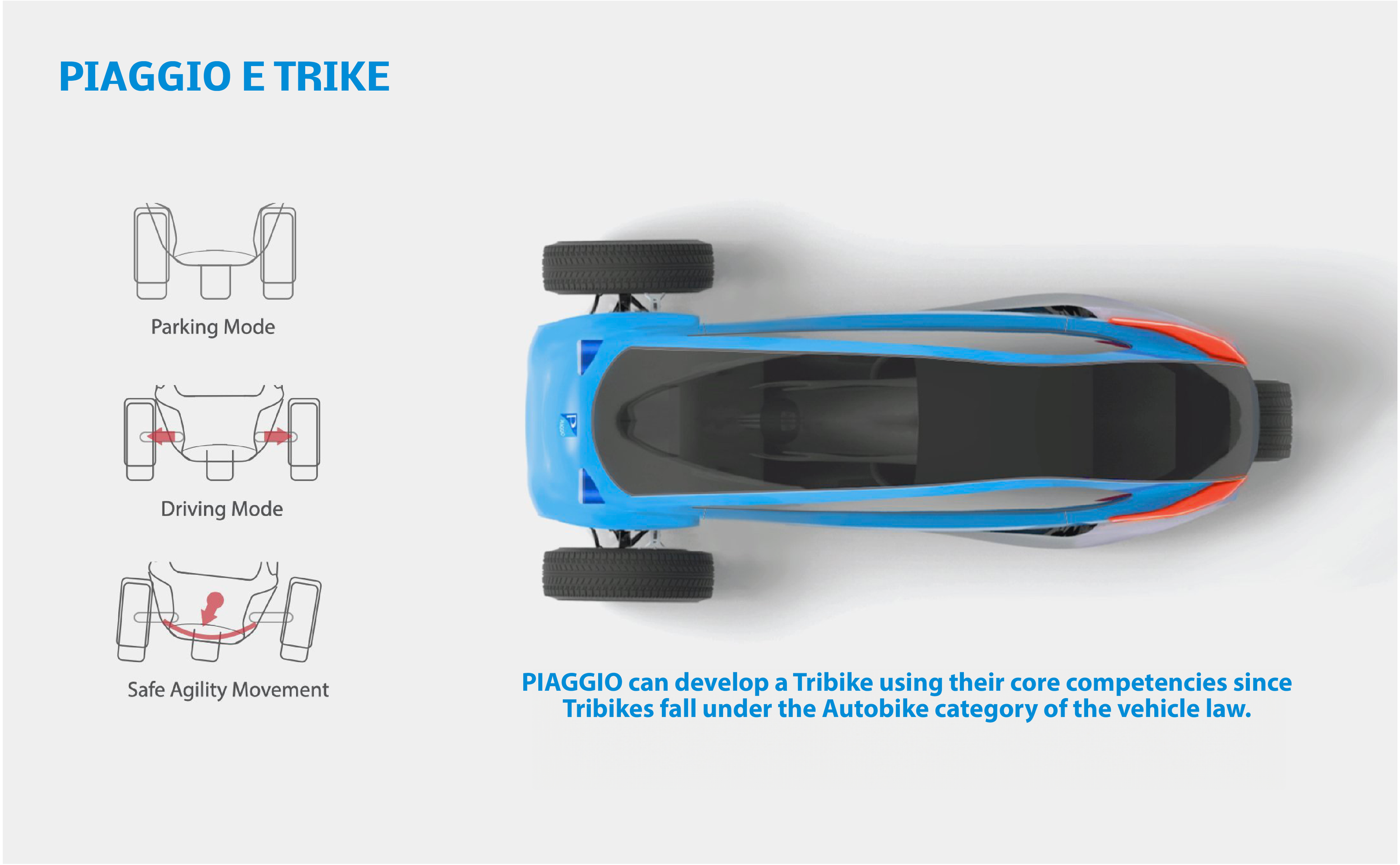
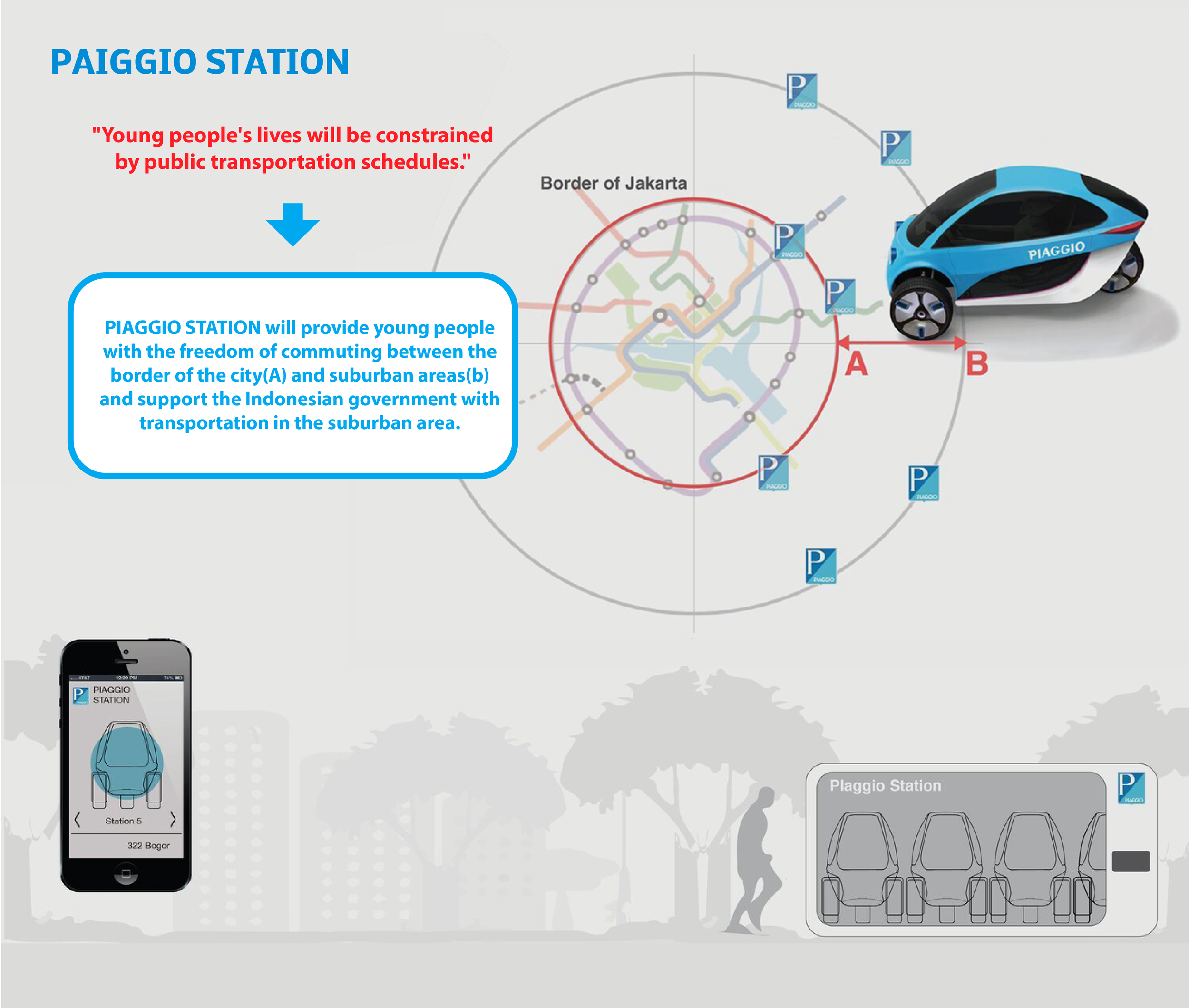
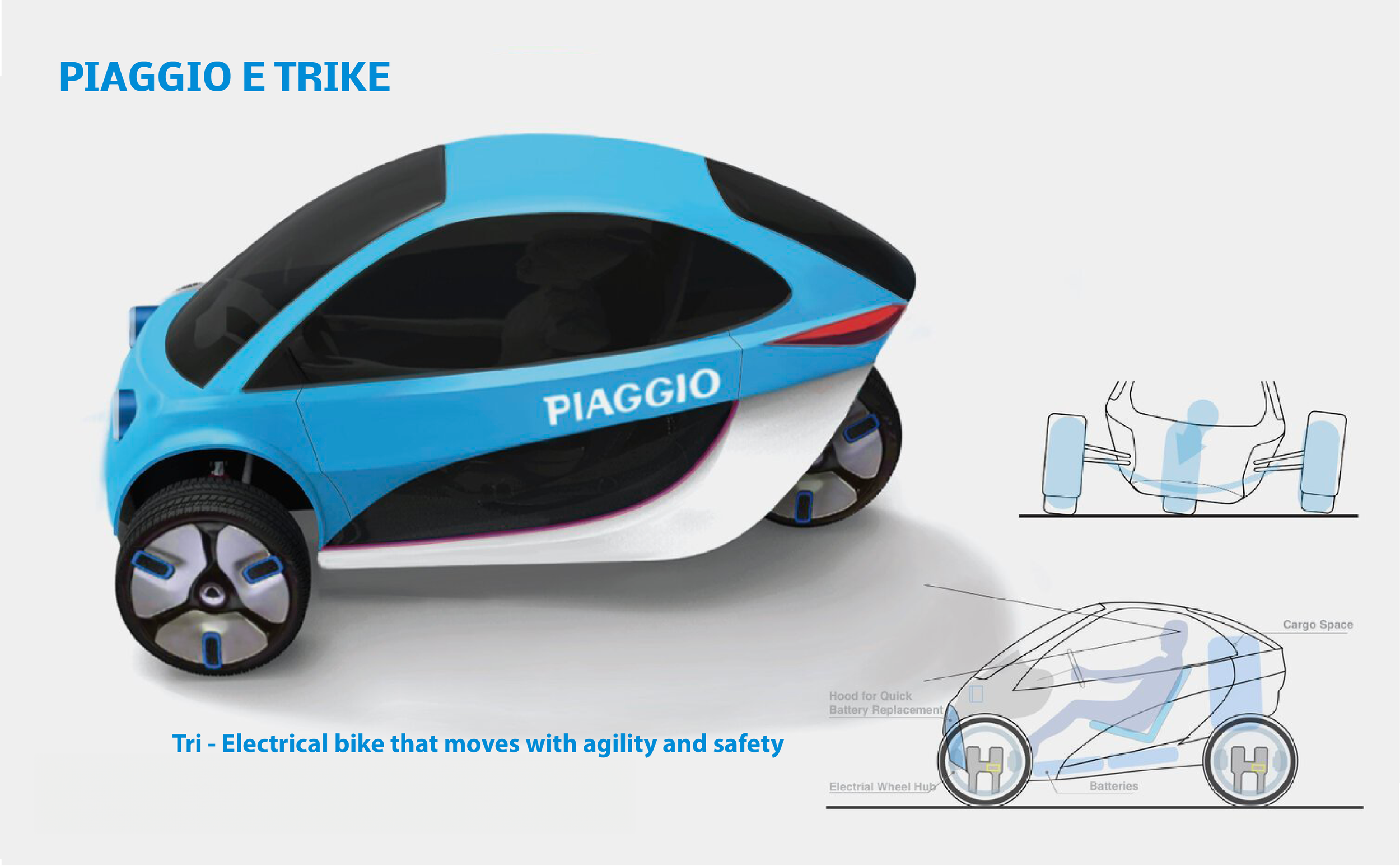
Designed PIAGGIO Station, a station-based mobility service for 18–30 suburban commuters in Jakarta that extends freedom beyond limited transit schedules. The concept paired an E-Trike with a protective shell to reduce safety anxiety while keeping the agility of two-wheel mobility. By combining on-demand rental access, station coverage, and an enjoyable personal-space commuting experience, PIAGGIO could shift from a product-only motorcycle brand to a scalable service-based mobility model.
STRATEGY
01. What to Achieve
Frame Question
How can PIAGGIO create a new mobility business model that engages young commuters in 2022–2023?
Outcomes
Optimize PIAGGIO’s competencies for future transportation needs
Reestablish the brand with a clearer identity and vision
Recalibrate PIAGGIO’s scope toward scalable service-based growth

02. Where to Play
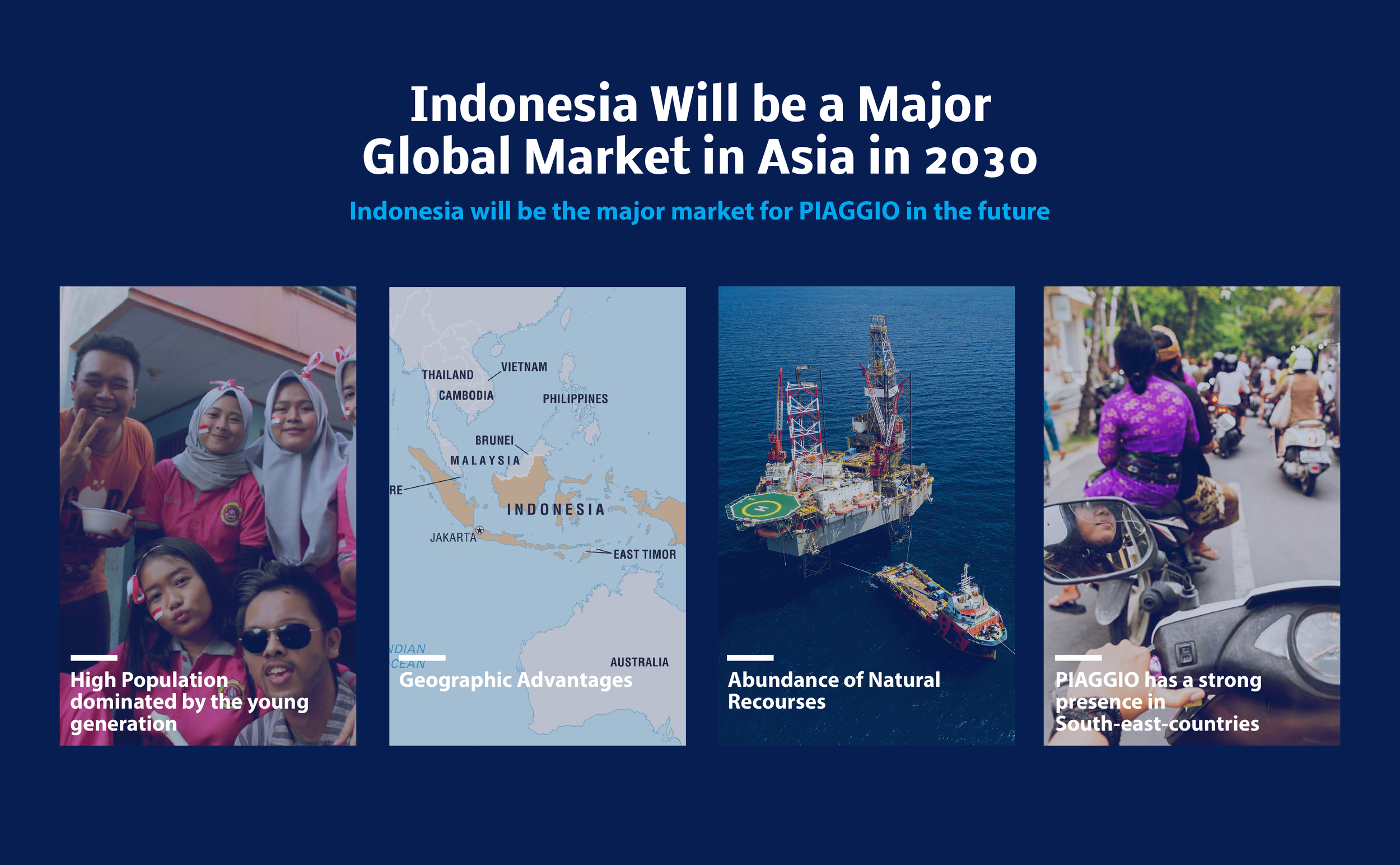
Geography: Indonesia, identified as a major future growth market
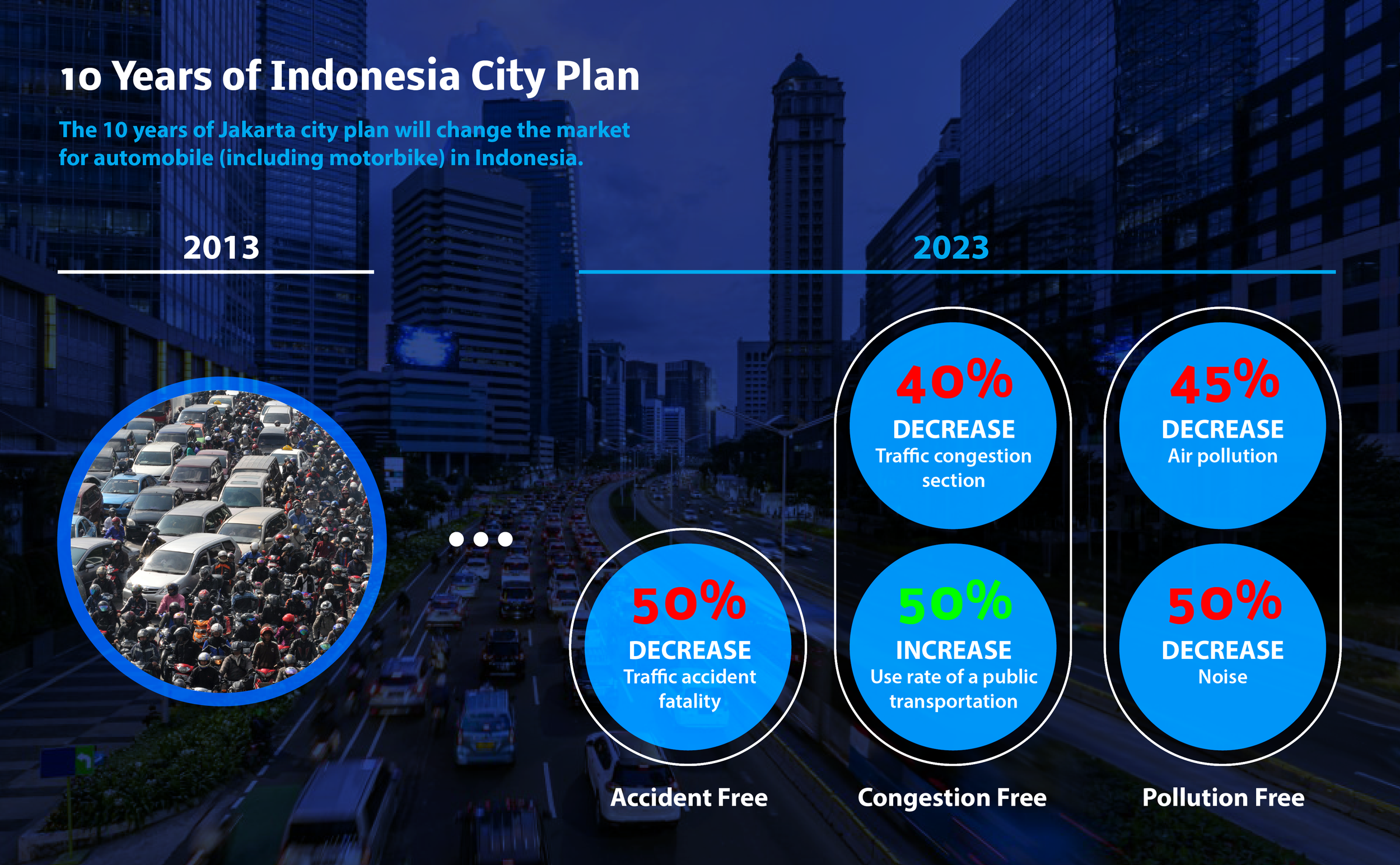
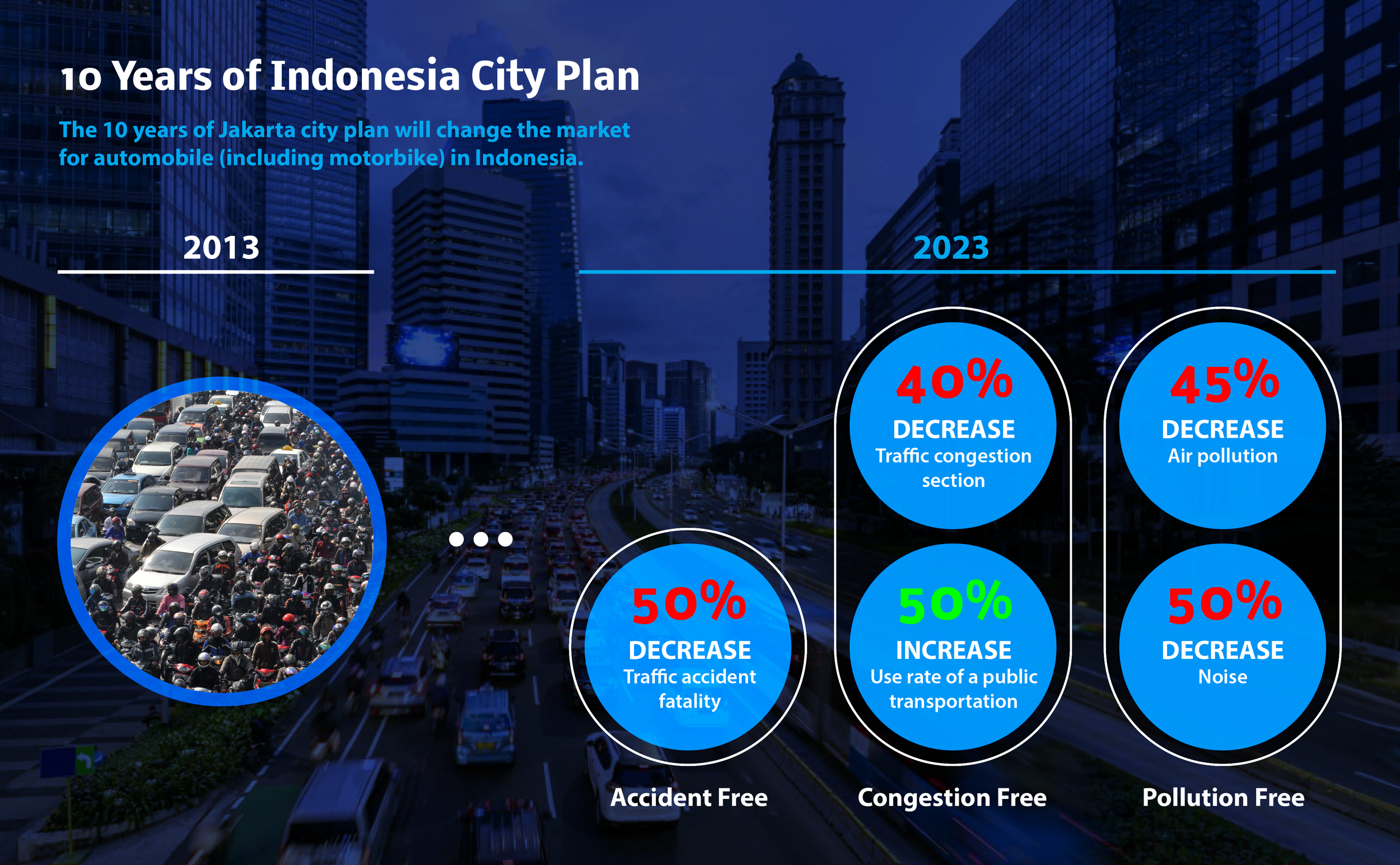
City context: Jakarta, where congestion, pollution, and stricter enforcement were expected to intensify
User segment: 18–30 suburban commuters whose mobility is constrained by limited public transportation schedules
03. How to Win
Freedom beyond transit schedules: Provide on-demand station access so young commuters can travel when they need to, not when public transportation allows.
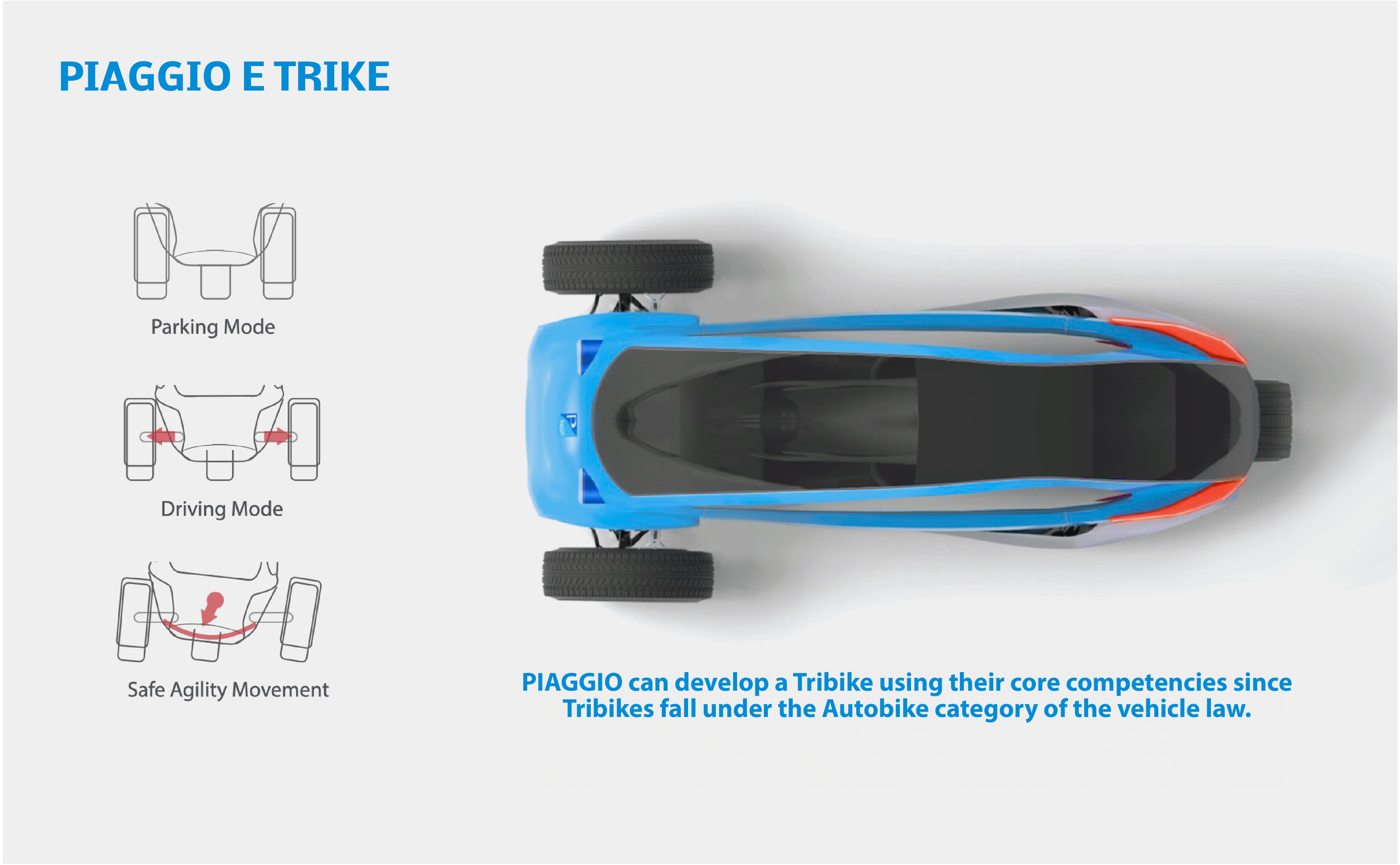
Safer personal mobility: Offer an E-Trike concept that preserves agile movement while adding protection to reduce safety anxiety for everyday commuting.
A commute experience that feels enjoyable: Create a more comfortable “personal space” that fits Gen Z lifestyle expectations, not just transportation utility.
04. Capabilities to Implement
Develop an electric power system optimized for daily commuting and sustainability
Design a protective shell to improve rider safety and comfort
Build infotainment and data software for user experience and service optimization
Implement a rental management system for pricing, access, and fleet operations
Establish PIAGGIO Stations to enable rentals and suburban coverage
05. Management System to Grow
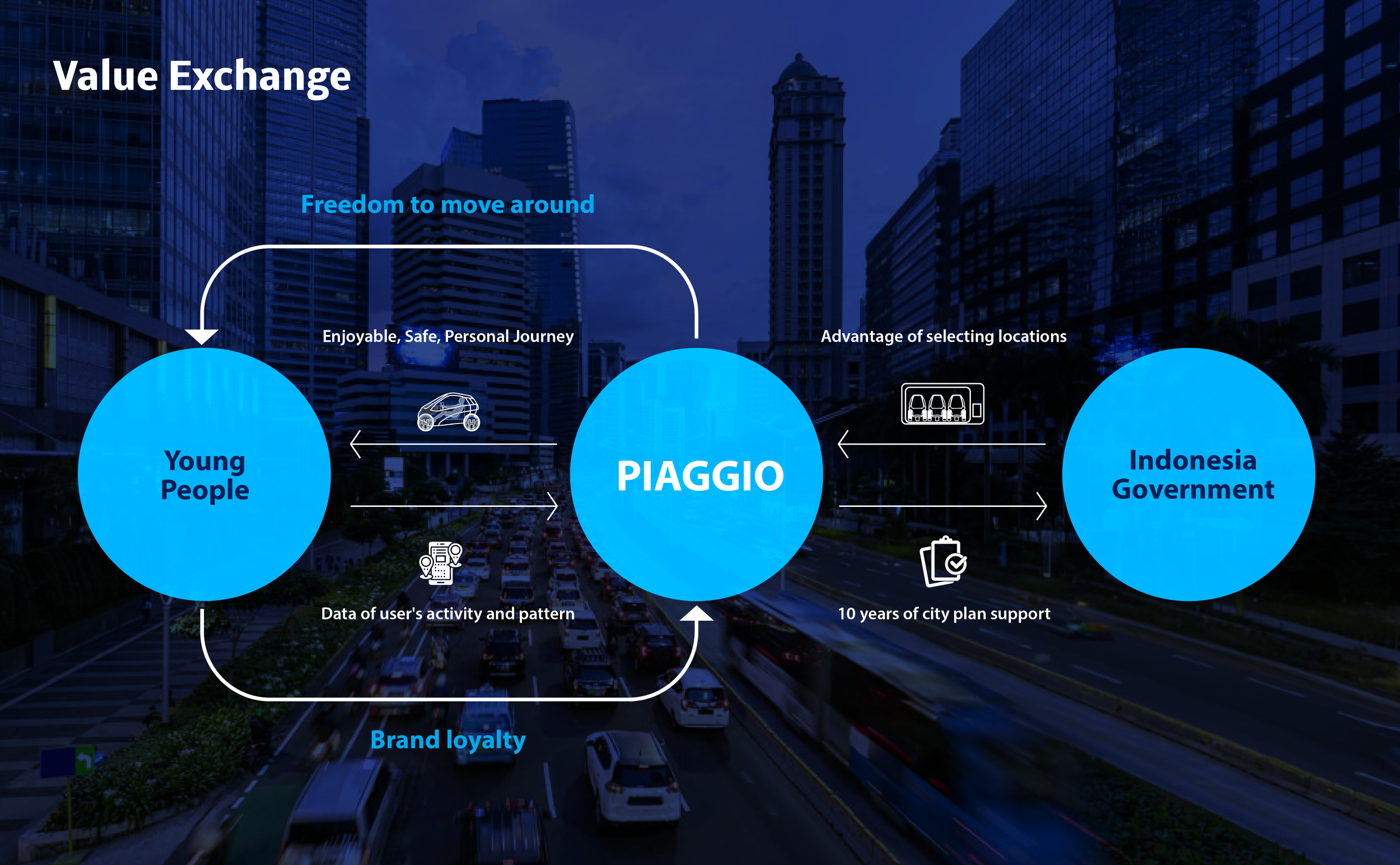
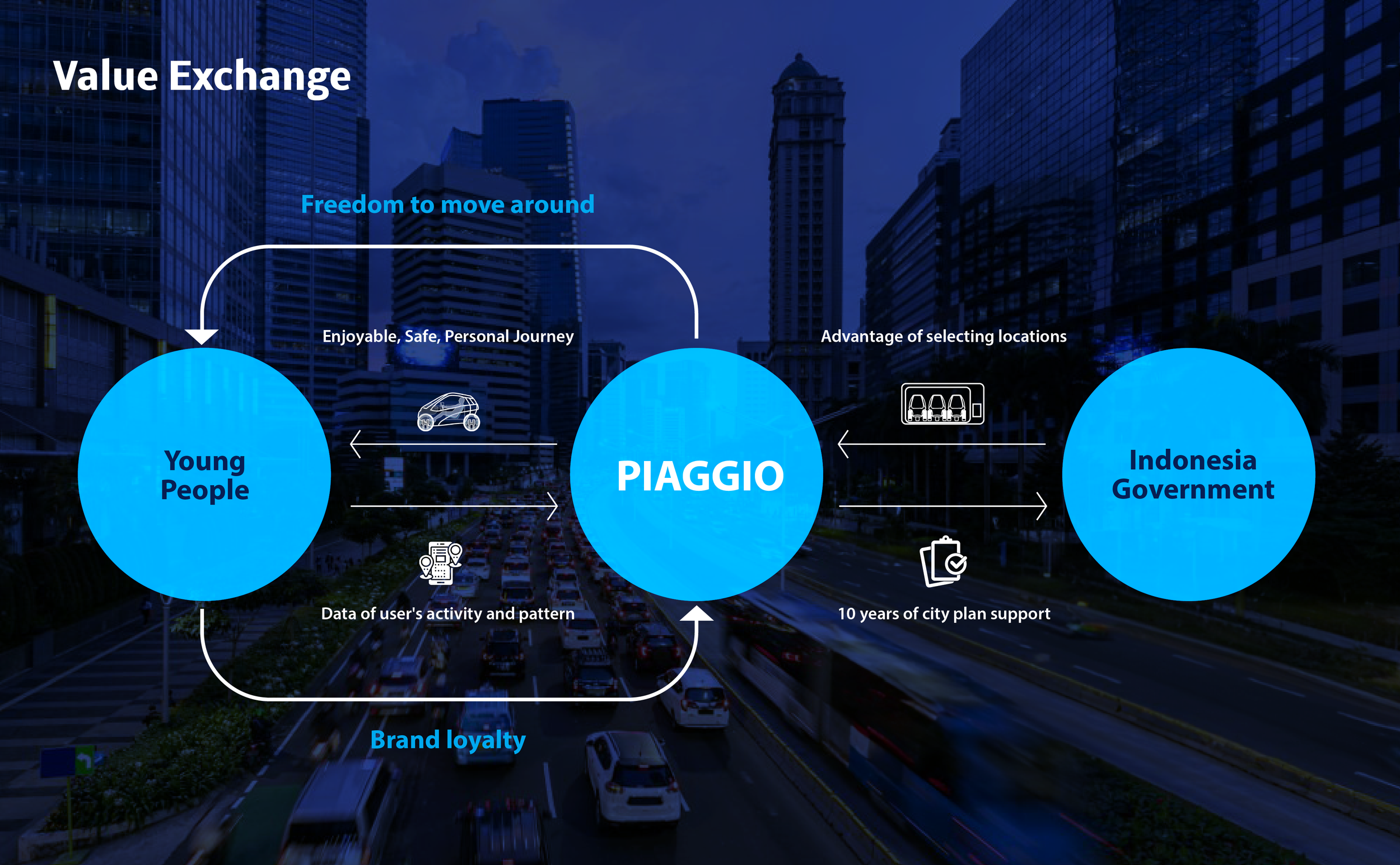
Use a value exchange map to track outcomes across riders, PIAGGIO, government, station operators, and partners
Measure rider value (safe, enjoyable commuting), business value (rental + maintenance revenue), and public value (reduced congestion/pollution)
Improve station placement, product features, and operations using usage data and partner feedback loops
06. Next Step / Future Foresight
Partner with the Indonesian government to scale PIAGGIO Station over a 10-year horizon
Expand station coverage to support suburban growth and reduce dependence on limited parking
Position the service as a solution for congestion, pollution, and noise as enforcement tightens
Build long-term capabilities in rentals, software, and fleet operations to sustain the model