WINNING STRATEGY
Designing a Playing to Win
Strategy for Viable, Feasible,
and Desirable Solutions
Over the past 10 years, I’ve grown as a design strategist by consistently applying a structured approach I rely on: the Winning Strategy. Inspired by Roger Martin’s Playing to Win work at P&G, it’s built on five connected questions that help teams make stronger strategic decisions.
Combined with design thinking, this framework helps me create solutions that are viable for the business, feasible to execute, and desirable for users. In the Product Strategy section of my portfolio, I use these five questions to show the strategic reasoning behind each outcome.
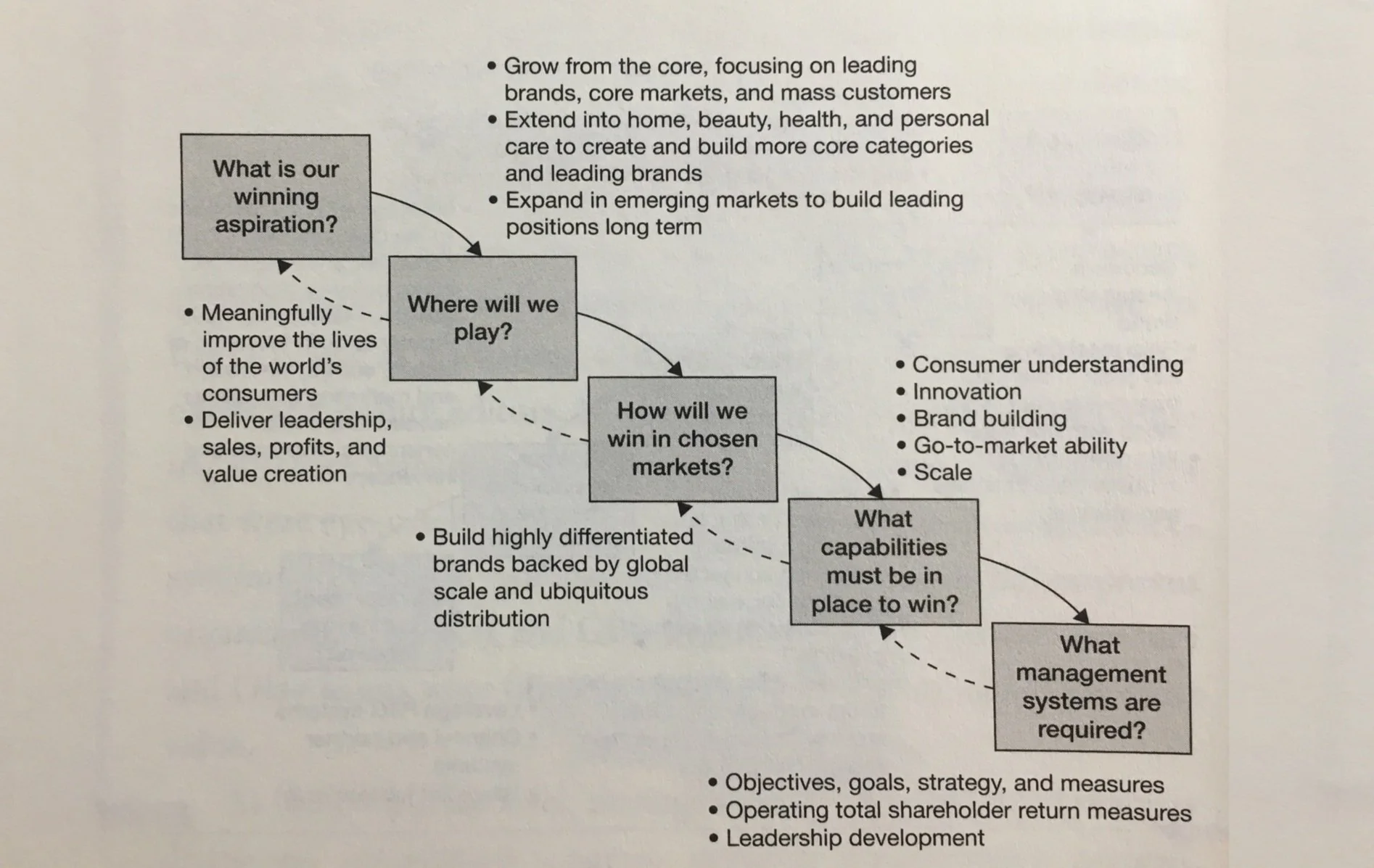
1) What is our Winning Aspiration?
Defining the Goal and Outcomes
Every project starts with clarity. The team needs a shared vision and a clear set of goals so we stay aligned as decisions pile up. My role is to distill the goal into one strong sentence, then collaborate with the team to define measurable outcomes that everyone understands. It’s not always easy, but it matters because it becomes the anchor. When we use the Winning Strategy framework, every decision and step can be traced back to the aspiration—so we stay focused, intentional, and on track.
2) Where will we Play?
Choosing the Strategic Playing Field
In the research stage, we define the playing field: which market, customer segment, and geographic context we’re building for—and what those customers actually need within their real-world constraints. I often think about this through two solution types: value-driven and product-driven. Product-driven solutions compete by adding features within an existing market. Value-driven solutions create space by solving a specific unmet need for a defined segment—often forming an uncontested niche. A classic example is Yellow Tail, which simplified wine selection and taste to create an accessible experience for entry-level wine drinkers. Even in traditional markets, you can create a unique space by focusing on the right customer needs.
3) How will we Win in chosen markets?
Designing a Winning Value Proposition
Once we identify target customer needs, the next step is designing a product and a plan to win in that market. This is where I rely heavily on one of my core strengths: the product user journey map. Using customer insights, I develop personas and storyboards that show how the solution fits into users’ lives and solves the problem end-to-end. Storyboards become a blueprint—connecting the user experience to marketing and customer management strategies. But these assumptions can’t remain assumptions; they must be tested and validated before scaling.
4) What Capabilities must be in place to Win?
Building the Capabilities behind “How to Win”
A strategy is only real if a team can execute it. In this step, we identify the key activities and capabilities required to deliver the value proposition—so we can judge feasibility and viability early. For example, when I built a photography service for B2B fashion e-commerce sellers, we defined four essential capabilities: online ordering development, photo studio operations, partnerships (model agencies and shipping carriers), and customer management. These capabilities were intentionally aligned with the platform’s core strengths, helping us build an ecosystem that strengthened the main business.
5) What Management Systems are required?
Establishing a Strategic Review and Measurement System
To support a successful launch and develop the service, I build a clear measurement system and share it with all stakeholders. Product progress can’t be evaluated by profit alone—especially in early phases where the focus may be learning, adoption, or market activation. Without shared expectations, teams can misalign and lose momentum. I experienced this on a project where some stakeholders expected profitability within five months, even though the team was still in the promotion and marketing stage. That moment reinforced a core lesson: teams need a shared set of metrics, a shared timeline, and consistent review rituals to move forward together.